Ski Bag Station: Beach DX & Kids Build a Flagpole in 90 Min
Operator Report — Portable DX
Puget Sound Beach House, Solar Cycle Trough,
50 Watts — Heard Worldwide
KQ7W · Jon KL2A · 20’ DX Vertical Antenna · Puget Sound, Washington
There are two ways to test an antenna. Run it at the peak of the solar cycle when everything works, or run it at the bottom — when conditions are genuinely bad and the antenna has to earn every contact. This trip was the second kind.
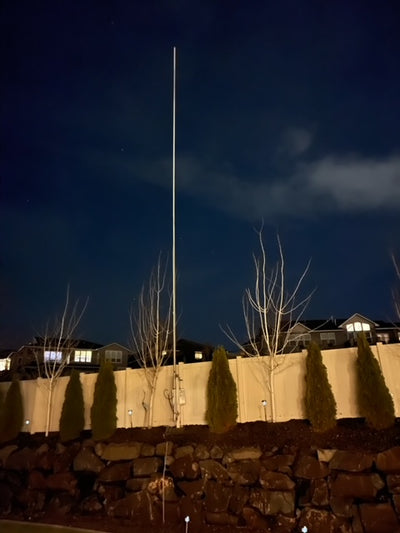
KQ7W is a callsign with a rare W7 prefix held by a friend. Jon borrowed it for a weekend operation from a beachfront QTH on Puget Sound, near Seattle. The antenna was the 20’ DX Vertical, transported in a ski bag that fits in a car trunk. Setup time: minutes. The bands were not cooperative. What happened anyway is the story.
“Please excuse the LID'ery — it was freezing at night. I was wrapped in a sleeping bag, just the fingers out for the CW paddle, with only the light from the laptop, radio, and the stars. A real good time.”
— Jon KL2A / KQ7W · Founder, Greyline Performance · CWops #77
What the Beach Adds — and What It Doesn’t Have To
Salt water is a near-perfect ground screen, and every vertical near it benefits: the reflection it provides strengthens the low-angle signal that works DX. A Greyline gets that bonus too — which is part of why this beach QTH played so well.
What the VDA doesn’t need is a radial field. The feedpoint is up on the pole and the lower half of the dipole carries the return current, so there is no buried wire to lay and no radial loss in series with the feed. Put the same antenna on rock, desert sand, or a concrete park pad and it works the same way — the ground still shapes the far-field pattern, as it does for every vertical, but nothing about setup changes. That’s what makes it a true portable system rather than a beach-only curiosity.
RBN: Heard Worldwide at 50 Watts
The Reverse Beacon Network screenshot below is from this operation. Solar cycle trough. 50 watts. 20’ VDA. The spots speak for themselves.

RBN reception report — KQ7W · 50W · 20’ DX Vertical · Puget Sound, W7 · Solar cycle trough.
Live Audio — On the Air from the Beach House
These recordings capture actual operating from this QTH. Listen for the background DX — at 50W during a solar trough, there’s more happening than you’d expect. The late-evening 20–40M opening is worth a listen.
Audio — 7QP Contest
7th Call Area QSO Party
Live 20M audio, mid-day. FL, CA, AK, New England worked.
▶ Listen →The Ski Bag System — Car Trunk to QRV in Minutes
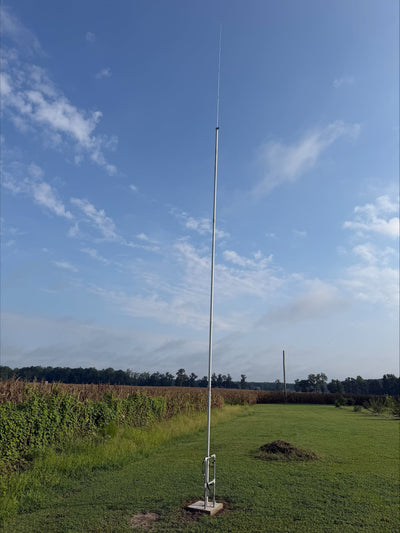
The whole 20’ antenna travels in 4-foot sections in a ski bag and fits in a car trunk or truck bed. No special vehicle. No trailer. No advance planning beyond picking a destination. Arrive, assemble, operate.
Weight: about 23 lbs for the 20’ · Transport: ski bag · Setup: minutes · No radials to lay
Photo Gallery — 7QP Ski Bag to Beach House
Setup sequence, Puget Sound QTH, 7th Call Area QSO Party.
View Photo Gallery →Schoolkids Build a DX Antenna in 90 Minutes
The same assembly simplicity that makes the ski bag system work in the field makes it accessible to anyone. A group of schoolkids assembled a full 20’ DX Vertical in 90 minutes — no prior experience, no special tools. If that’s the build time for first-timers, the experienced operator gets on the air considerably faster.
Photo Gallery — Schoolkids Build
Full assembly sequence. First-timers. 90 minutes start to finish.
View Photo Gallery →What This Means for Portable Operators
POTA activators, SOTA operators, Field Day teams, and anyone who wants a serious HF antenna away from home face the same constraint: the antenna has to go somewhere, set up fast, and perform on whatever ground exists at that location.
Radial-dependent verticals need soft ground, a spool of wire, and time to deploy a ground system before the antenna can do its job. The VDA skips all of that: the lower half of the dipole does the radials’ job. Park concrete, beach sand, granite summit, parking lot — no radials to lay, anywhere.
The Portable Advantage
Footprint. Noise. Portability. A 2-inch pole and nothing on the ground. No radials extending toward neighbor noise sources — or toward the parking lot. Self-supporting. No radial field. Ready in minutes.
More from the Greyline Operator Network
KJ7CWQ — Roy
16’ DXF — 160–6M Confirmed
Phoenix HOA. SGC-237 tuner. Full SWR table.
WC0R — Rob Freedman
20’ DXF — Defense Antenna Executive
A professional’s assessment of the build.
K3WA — Bill
20’ DXF — CW Sweepstakes Clean Sweep
1,000+ QSOs. PVRC president.
K3WA — Bill
24’ DXF — 160M Contest
61 QSOs on 160M.
KL2A — Jon
28’ DXV — Install Day
EU on 80M and 160M same night.
NN3W — Rich
28’ DXV — Independent Review
G4 on 160M first night. Detailed technical assessment.
Ready to Deploy
12’ through 28’ — every one travels in 4-foot sections. No radials. Built by hand.
Shop DX Vertical Antennas →Ham Radio is fun again! Pass it on… 73, Jon KL2A
Greyline Performance · Sun Valley, Idaho · Contact · 435-200-4902
Read next · Getting Started
Greyline Life
How Greyline Works: The Clubhouse, The Bookshelf, The Tools, and You
Field Notes
Why Your Greyline Ships In Two Boxes
Operator Spotlight
W7TLG: Black Beauty on the Bench - An Engineer's Build
Everything on Getting Started →