20 Meter Vertical Antenna: Which Height Works Best?
SIGNAL LAB

20 Meter Vertical Antenna: Which Height Works Best?
Choosing a height for every band, not just 20? What height should I buy? — the one-page answer →
Short answer: on 20 meters, every height in the Greyline line works, and works well. Twenty is the friendly band. At 14 MHz even a modest vertical is a substantial fraction of a wavelength, the ionosphere cooperates most of the day, and low-angle DX radiation comes almost free.
The longer answer is more useful. Every antenna in this line covers 160 through 6 meters. All of them. Height does not decide which bands you get. It decides how much aperture you have on the low bands, and where a little bonus gain lands. Every height is a good answer on every band.
Why 20 Meters Is The Easy Band
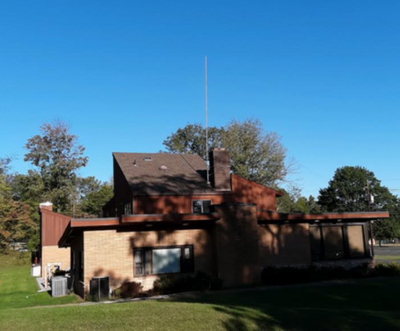
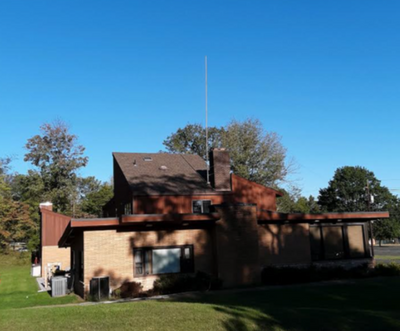
A wavelength at 14 MHz is about 67 feet. A 20-foot vertical dipole is already a serious electrical length there, and taller poles push further into the region where verticals concentrate energy at the low angles DX arrives on. That is why the smallest antennas in the line post real 20 meter results: Ted, K8AQM, worked 56 countries in a four-hour sitting on a 20-foot flagpole from his yard, and operators log daily transatlantic FT8 on every height we build. On 20, you are choosing between good and good.
Every Height Works Every Band — Plus a Bonus
As a vertical approaches five-eighths of a wavelength, its current distribution compresses radiation toward the horizon and adds a little extra gain. We modeled every Greyline height in NEC — total height, feedpoint section included — so we know where each one gets that bonus. It is a bonus on top of full coverage, never a limit.
Where Each Height Gets Its Bonus (NEC)
12 & 16 ft build toward 10M · 20 ft bonus on 10M · 24 ft bonus on 10–12M
Skyline 29 & 33 bonus on 17M, about +3.5 dBi · Skyline 37 bonus on 17M, about +4.0 dBi, reaching toward 20M
Every antenna above covers 160 through 6 meters. The bonus is extra. See every band in the VDA Optimizer →
Notice that the shorter antennas get their bonus on the high bands. A 16-footer is not a smaller version of a 28-footer waiting to grow up. It works the whole dial, and on 10 meters it is doing exactly what the physics asks. Nobody needs to apologize for a 16-foot antenna.
Why The Line Stops At 28 Feet
This is a design decision, not an accident. Go far enough past five-eighths of a wavelength on a band and the pattern begins to lobe upward: the radiation angle climbs and the antenna starts sharing its energy with higher angles. On the high bands that point arrives sooner, because the wavelengths are short.
So the core line is bounded on purpose: tall enough to reach down toward 40 and 80, and short enough that the HF bands keep their low angle. When an operator wants to go beyond that window, deliberately and with his eyes open, that is what the Skyline and Experimental series are for.
Every height covers everything. Height decides how much low-band aperture you carry, and where a little bonus lands.
Where Height Pays Most
Drop to 40, 80, and 160 and the physics turns strict. John Kraus, W8JK, set it out in Antennas: radiation resistance falls with the square of length measured in wavelengths. Halve the electrical length and the antenna's useful resistance drops fourfold, so every ohm of loss takes a bigger bite of your power. At 3.5 MHz a wavelength is 280 feet, and no backyard pole is long there. Every foot you add claws back radiation resistance where it is scarcest.
Bill, K3WA, moved from a 20-foot to a 24-foot DX Flagpole and called the low-band difference very big, then worked 61 stations on 160 meters from an HOA lot. That is four feet doing real work at the bottom of the spectrum, without giving anything up at the top. The 3830 contest score archives tell the same story at scale, year after year.
Which Height Is Yours
Start with your lot, not a band. Every option below covers 160 through 6.
Your lot and your HOA decide the ceiling. Wind rating, what the neighbors see, and what the household will approve set the tallest height that makes sense. Whatever that number is, it is your antenna, and it works the whole dial.
Then take every foot the ceiling allows. More height is more aperture on 40, 80, and 160 — the one thing no tuner can fake — and the high bands come along with you.
Then enjoy the bonus. Whatever height you land on carries a little extra somewhere on the dial: 10 meters on a 20-footer, 10 to 12 on a 24, 17 on a Skyline. Add the 9-foot whip later and the bonus moves down the bands while everything else stays.
Sixteen feet is your ceiling, full stop? Then 16 feet is your antenna, and it is a good one: all band, 160 through 6, and operators have worked the world with less. The best antenna is the one that goes up in your yard and stays there.
And whatever height you choose, it works 20 meters on day one. That part was never in question.
See the 20' DX Flagpole → See the 24' DX Flagpole → Run Your Own Height →
Two Ends Of One System. The 9' DX Whip on top adds aperture and moves your bonus down the bands without buying a new antenna. The Tilt-Up Base at the bottom brings the antenna to working height, one person, one bolt, and is how you reach the top to put the whip on.
The Full System — Signal Lab Curriculum
Aperture & Length: What Height Should I Buy? · How to Read Antenna Gain · What Your Antenna Actually Grabs · Why Your Antenna Hates 80 Meters
Propagation: Grey Line, Answered · The Skip Zone
The Feedpoint: Current Balun Vs Voltage Balun
The Feedline & Tuner: Do I Need a Tuner? · Indoor vs Remote ATU · Feedline Loss Calculator
Ground & Radials: No Radials Means Two Things · Do I Need to Ground It?
By Email: Get the Field Guide — the Signal Lab in your inbox
Based in Sun Valley, Idaho · Made in the Mountain West
73 — Jon, KL2A · 435-200-4902
Ham Radio is fun again! Pass it on...
Read next · Height & Gain
Greyline Life
Half My Pileup Gone: A Thousand Pounds of Aluminum for the Butte
Signal Lab
Nine Feet You Have Not Used Yet: What the Whip Actually Buys
Signal Lab
The Other Half of Your Antenna Has to Go Somewhere