9-Foot DX Whip: Three Operators, Three Field Reports
GREYLINE FIELD REPORTS · OWNER CLUB

Three Operators. Three Installs. Three Things Worth Knowing.
Three Operators. Three Field Reports. One Antenna.
We get a lot of field reports. Most of them go in the file and inform the next product decision. A few are worth sending around — not because they make good marketing, but because they teach something specific that other Greyline owners might use.
Here are three from the past few months. Different heights. Different states. Different operating styles. None of these three operators is running the 9-foot DX Whip extension with their antenna — we mention that up front because the question always comes up. These are reports of a base-model Greyline antenna doing the work.
Three minutes. Read on.
K3WA
Clean Sweep on Sweepstakes. From an HOA Flagpole.
24-foot DXF Flagpole · North Carolina HOA · PVRC president · kW amplifier
K3WA is the president of the Potomac Valley Radio Club — one of the strongest contest clubs in the United States. His station is a 24-foot DX Flagpole Antenna, fully HOA-acceptable, in a North Carolina subdivision where most of his neighbors have no idea there is an HF station next door. He runs a kilowatt amplifier behind it.
In the November ARRL Sweepstakes, K3WA logged over 1,000 QSOs and worked all 84 USA sections. A clean sweep. From the flagpole.
The technical why
The 24-foot DXF on its own hits the 5/8λ sweet spot on 12 meters, and it covers 160-6M from a single feedpoint with no buried radials. For Sweepstakes, where 20M and 40M carry most of the contact volume, the DXF’s elevated dipole feedpoint gives him low-angle radiation on the workhorse bands and the WARC coverage to pick up multipliers on 30M, 17M, and 12M all on the same antenna if he so chooses. The kW amp closes the gap on signals that the antenna alone gets close to but not over.
NN3W
First Night: Five Continents Before Bed.
28-foot DXV bare vertical · Drake L7 amp 800W · MFJ shack tuner · 150 ft coax · Virginia · independent reviewer
NN3W is a longtime DX operator and an independent reviewer — he has no business relationship with Greyline beyond being a customer. He published his field report on his own platform before Greyline had any opportunity to influence it.
First night with the 28-foot DXV installed:
- 160M: G4 (England)
- 80M: LZ (Bulgaria)
- 40M: KP4 (Puerto Rico), 9K (Kuwait), KH6 (Hawaii), CE (Chile), and Europeans
- 20M: TZ4 (Mali)
Next morning, on 40 meter CW during the CWops CWT contest: 31 QSOs in 15 minutes.
The technical why
NN3W’s station is not modest — Drake L7 amplifier behind it, MFJ shack tuner at the desk, 150 feet of coax to the antenna, no remote ATU at the base. He runs the whole thing through coax to the shack and tunes there. The 28-foot DXV at 5/8λ on 15 meters gives him strong low-angle radiation for DX on the higher bands. The same antenna covers 160M and 80M for low-band DX with the shack-side tuner handling the impedance match.
The point worth making: this is a contest-grade configuration — big tubes, MFJ desktop tuner, long coax run — running on the same antenna line that ships to first-time HOA buyers. Same physics. Different operating intent.
WC0R
A Defense Antenna Executive Goes On the Record.
20-foot DXF Flagpole · Colorado HOA · Concrete foundation · Retired defense antenna executive · Amateur Extra
Rob Freedman, WC0R, ran a defense antenna company for seven years before he retired. He knows what professional-grade antenna engineering looks like from the inside. When he ordered a 20-foot DXF for his Colorado HOA, he expected to be disappointed. He has seen too many ham radio products that look the part and don’t deliver.
After install, he wrote:
HOA approved. Concrete foundation. FT8 DX confirmed to Hawaii, South America, Europe, and Africa from a 20-foot flagpole in a Colorado subdivision.
The technical why
WC0R’s evaluation is worth weighting because he isn’t reading marketing copy and reacting — he’s comparing what he received against the antenna engineering standards he applied for seven years professionally. His specific call-outs were the 2″ OD, the graduated wall thickness (0.125″ lower 30%, 0.065″ upper 70%), the ASCE 7-10 wind rating with cited methodology, and the 316 stainless hardware. None of those are common in commodity ham antennas. All of them are standard in defense procurement.
The Pattern Across All Three Reports
Different heights. Different geographies. Different operating styles. One thing in common: each operator is working 160-10M with great success on the Greyline antenna.
K3WA uses the 24-foot DXF to compete in radio competitions with his friends, year round, with real results.
NN3W uses the 28-foot DXV for 30-10M as a second antenna for multipliers in his contesting and DXing.
WC0R uses the 20-foot DXF to keep his FT8 numbers up across the WARC bands.
Same antenna line. Three different operating styles. One pole, 160 through 6 meters, no buried radials.
If You’ve Been Thinking About the 9-Foot DX Whip
None of the three operators above runs the 9-foot DX Whip with their station — their results are from the bare antenna. We mention this because the question comes up: do I need the whip to get results like these? No. You don’t.
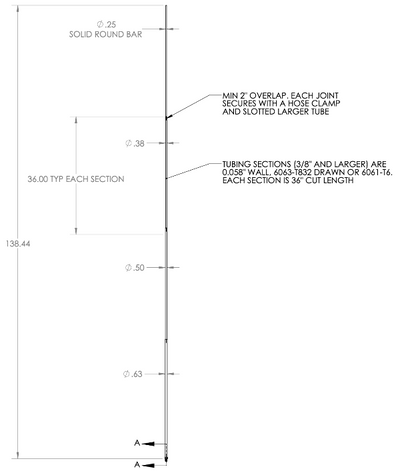
The whip is a separate consideration. It is an adjustable extension, 3 feet to 11.5 feet, that bolts onto the top of any Greyline VDA. Adding it shifts the antenna’s electrical resonance to land on a 5/8λ sweet spot for a target band — typically the WARC bands (17M, 12M), or a half-wavelength on 20M depending on the host antenna height.
The point of the whip isn’t more bands. The bare antenna already covers 160-6M. The point is concentrating extra dB on the bands you care most about. For a DXer chasing 17M openings, or a contester wanting an extra few dB on 20M during prime hours, the whip lets you tune your antenna’s sweet spot to your operating priority.
If you have been operating without the whip and you have wondered whether it would change things — here is where to learn the physics and see the tuning curves:
Why This Works — the Aperture Argument
All three of these field reports point at the same underlying physics. When a Greyline VDA sits at 5/8λ on a target band, the current distribution and feedpoint behavior put the antenna’s effective aperture in the position where the physics rewards it — elevated, dipole-balanced, with the current maximum above the lossy near-field ground.
Aperture, properly positioned, is the metric that matters. Not arbitrary length ratios. We wrote a full doctrine page on the physics if you want to read it: Antenna Aperture and Gain — the Honest Physics →
If you are a Greyline owner with a field report worth sharing, send it. Real numbers, real conditions, your real install. We will publish it with credit. — Jon KL2A
73 Greyline — 435-200-4902
Ham Radio is fun again. Pass it on.

Read next · Skyline & Whip
Operator Spotlight
Eighty Meters After Twenty-One Years
Operator Spotlight
Two Weeks of Voicemails, Then This: W3GF's 20-Footer and the Whip in a Florida HOA
Signal Lab
Nine Feet You Have Not Used Yet: What the Whip Actually Buys
Everything on Skyline & Whip →