Summer Camp Portable: 160-6M HF Vertical Antenna, Go Kit

Campground Portable: a 28’ Greyline Vertical and 40 Watts in the Sawtooth Wilderness
The 28’ Greyline was so quiet on every band up on that high ridge, with what seemed a reflection of signals off the giant granite mountain to the east. Ham radio is so fun again.
If we could hear them, we could work them!
By Jon, KL2A/7 · Memorial Day 2021
At Greyline, we get long lists of emails, many asking for more examples of summer portable operation. Here’s one from last summer that showcases camping and RV travel operating. It applies to DXpeditions too: the antenna breaks down into 4’ sections and slips into a ski bag. I’ve taken mine from high mountains to ocean villas. Here are my short notes from the mountains of Idaho, one smoky fire-season weekend.
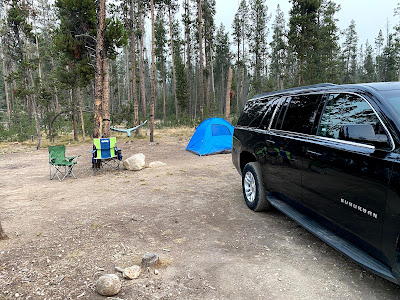
September 13, 2020: Sawtooth Wilderness near Stanley, Idaho.
Packed up my ski-bag ham radio go kit, including the Greyline HF vertical, and headed for the mountains of south-central Idaho, north of Sun Valley in the Sawtooths.
KL2A/P ski-bag portable station:
- Greyline 28’ OCF Vertical Dipole
- Icom 7610 transceiver at 40W
- LDG RT-100 remote tuner at the vertical
- Vibroplex Code Warrior Junior CW paddle
As luck would have it, there was a four-hour CW sprint — the NAQP (North American QSO Party) — Saturday night, just about the time I would land at a campground. These contests are very popular and the bands are full of activity for all four hours. I was excited to give the antenna a high-mountain-air test run, with lots of guys to try and work.
Arrived at the campsite amid a smoke bank coming in from WA/OR. It’s fire season, but the signals won’t mind. Such a super quiet location, and it took a while to find. Most spots were below a hill along a river; this one was along a ridge-line way up there.
Built the station in about 20 minutes and started the radio about halfway into the contest. Once on the air, I felt pretty loud considering half power or less at 40W. Almost everyone I called heard the signal. Wow.
“Almost everyone I called heard the signal, and they were indeed loud.”
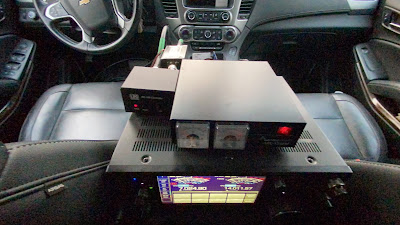
The Suburban’s 12V did not allow full power, so 40 watts was set.
The antenna is a 28’ Greyline HF vertical. At 35 pounds total I easily maneuvered it and tied it to a stump 75’ or so from the truck for the night. The included 3’ PVC sleeve and the ground-support section below the base insulator (not part of the radiating element) put the top at about 27’.
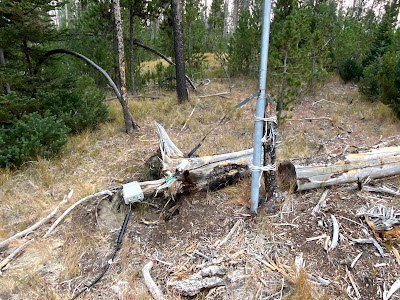
This antenna system’s order of parts: from the antenna, the ladder line transitions to the PL-259 adapter, which plugs straight into the LDG RT-100 remote tuner a few feet to the left of the pole. Then the RF choke — seven slip-over ferrite beads on the coax, on the radio side of the tuner — then 75’ of LMR-400 to the Suburban. That’s it.
That’s the choke rule in action: at the feedpoint with a shack tuner; on the radio side of the tuner when the tuner sits at the antenna. Your RF System, end to end →
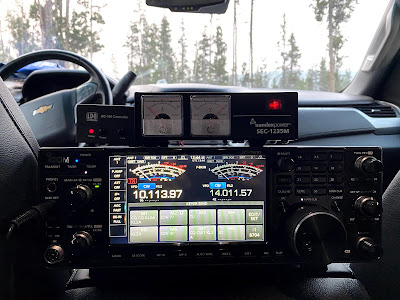
Cockpit: Icom 7610 at 40 watts.
The cockpit inside the Suburban was roomy and comfortable enough. Noted for next time: a tent, table, and chair.
Power: from the truck’s 12V outlet I got 40W out without tripping the Chevy’s breaker. The heater was on low to keep the fan noise down and the fingers warm.
Operation: 40M and 80M were hopping, full of CW signals from coast to coast. It felt like I was looking down on all of them from up there. So quiet compared to home. The tall granite peaks around me seemed to be reflecting signal in my favor — it certainly felt louder than my home QTH below the hill. Transmit and receive were both better from this rural high outpost.
“I could hear everything and everyone on the bands!”
W1–W4 signals filled 40 and 80M CW, and I worked the East Coast easily on both bands with 40W — not something I’d managed yet from the lake house with 100W. You have to hear them, right? Having guys hear me easily was a treat. Amazing what a quiet location and a high takeoff will do.
In the end I logged 140 QSOs in about 90–100 minutes on the air. My fingers were a little chilled, the mosquitoes were really trying to get in (some apparently did, judging by the itchy fingers on the way home), but it was all so very worthwhile. What a blast having a real antenna on the air once again.
The NAQP CW sprint is the “best four hours in radio!”
Bonus: tuned the bands at sunrise before packing out of camp. It was cold in the tent — 28°F at sunrise, and still smoky.
+ Found PJ4A (NN3W at the Bonaire station) on 20M in WAE SSB.
+ A 40M tune found W6YA working YF8HVY. A very quiet QTH in the mountain country.
W6YA + YF8HVY, 40M CW DX at sunrise
PJ4A (NN3W), WAE SSB 2020
In summary: just about any decent antenna at a great location will work well for you. In my case, a wire in a 50–60’ tree would work in a similar fashion to the Greyline vertical (we’ve tested it). The difference is that the Greyline goes up where there is no tree. I hope you find great adventure on the bands this season and your antenna serves you well. Have a great summer — we’ll look for you on the bands.
73, KL2A/7
From an owner: “I dug a hole in the back yard to please the wife, poured concrete, and then she says, ‘It’s beautiful, let’s put it in the front yard.’ I dug another hole.”
Greyline says: Sorry about the extra work — but how cool that the XYL wants it in the front yard, just where you wanted it in the first place. Good on you, sir.
CQ CQ, calling all Greyline owners
Will you share your DX adventures with us? Please send a picture or a YouTube video of your shack, your antenna, or the bands coming alive on your Greyline. We’d love to share your story with our peers around the world. Send us your story →
Related
- Ski-bag beach-house station: KQ7W on Puget Sound
- KJ7CWQ: 16’ DX Flagpole and SGC-237 remote tuner work 160–6M
- “Happy XYL” in Pennsylvania: Kevin’s 20’ DX Flagpole
- Bill in Florida one-calls XR0ZRC with 100W on a 20’ flagpole
- K7CWC Cliff in Washington, spotted worldwide on a 24’ DX Flagpole
- Do I need a tuner? Shack or remote
- Common Questions
Ham Radio is fun again! Pass it on… 73, Jon KL2A · 435-200-4902
Read next · Feedline & Chokes
Operator Spotlight
Eighty Meters After Twenty-One Years
Signal Lab
A Match Is Not A Result: What 1:1 SWR Does And Does Not Tell You
Signal Lab
Why Your Tuner Cannot Fix a Jumping SWR
Everything on Feedline & Chokes →