Nine Feet You Have Not Used Yet: What the Whip Actually Buys

Signal Lab
Nine Feet You Have Not Used Yet: What the Whip Actually Buys
Choosing a height from scratch? What height should I buy? — the one-page answer →
The question comes in almost every week, in some form: can nine feet of aluminum on top really matter? It is a fair thing to ask. The answer is yes, but not evenly, and not on the bands most operators expect. Here is what it actually does to a signal, and where the physics says the money goes.
The Physics, In One Idea
John Kraus, W8JK, taught the principle that governs all of this in Antennas: what matters is not how many feet of metal you have, but how many wavelengths. A 24-foot vertical is a substantial antenna on 20 meters and a very short one on 80. Radiation resistance — the part of the feedpoint impedance that actually turns current into radiated field — climbs steeply with electrical length. When an antenna is short in wavelengths, that radiation resistance is small, and it sits in series with the losses in your conductors, connectors, and matching network. The smaller it gets, the larger a fraction of your power those fixed losses claim.
This is why adding height pays unevenly. Robert J. Zavrel Jr., W7SX, frames it as an efficiency fraction in Antenna Physics: An Introduction (ARRL): radiation resistance divided by radiation resistance plus loss resistance. Nine more feet barely moves that fraction on 10 meters, where the antenna was already electrically long. On 40 and 80, where it was electrically short, the same nine feet moves it a great deal.
The practical translation: the whip pays most where you were struggling, and least where you were already fine. That is the opposite of how most upgrades work, and it is why operators who add one tend to describe the change in terms of the low bands rather than a number on a meter.
Where the Peak Moves
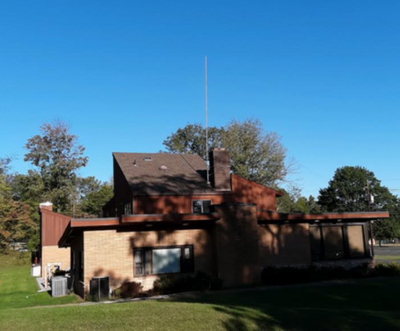
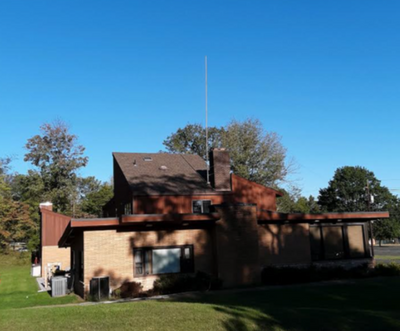
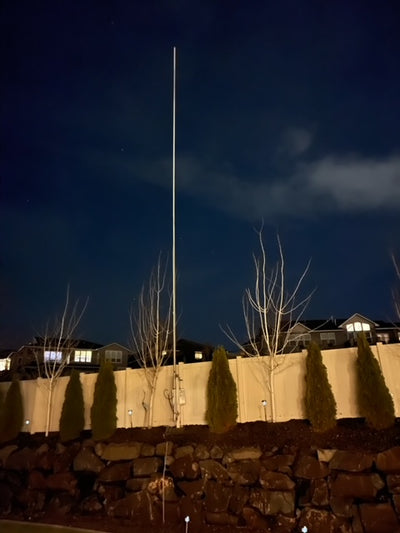
Every vertical has a band where it does its best low-angle work, and adding length moves that peak down the bands. We modeled every Greyline height in NEC, total height including the feedpoint section, so the numbers are real modeled gain, not rules of thumb. The bare 20-foot peaks on 10 meters and the 24-foot on 10 to 12. Put the whip on top and all three Skylines peak on 17 meters — and the gain climbs with height: about +3.5 dBi for the Skyline 29 and 33, and about +4.0 dBi for the Skyline 37, which pushes its peak toward 20 meters. On 40 and 80 none of them is near its peak, which is exactly why the extra length pays most there. The VDA Optimizer shows the modeled gain for your height and band.
Those three combinations are exactly the Skyline Series — 29, 33 and 37 feet. If you already own a 20, 24 or 28 footer, adding the whip is how you build a Skyline yourself, and it costs a fraction of a new antenna.
What It Does Not Do
It will not fix a bad feedline. It will not make up for a missing choke. It will not add a band your antenna does not already cover, and it will not turn a 12-footer into a low-band station — the physics above cuts both ways, and on the shortest antennas the fixed losses still dominate.
And it is not free structurally. Nine feet of whip is nine feet of lever arm on the joint below it. The whip is built light for that reason, but if you live where the wind gets serious, this is a piece to bring down ahead of a storm along with the flag. Our storm rule stands: when the forecast turns, flag down, nothing on top.
The Part Nobody Thinks About Until Install Day
A whip goes on the top. The top is the one part of a vertical you cannot reach from the ground. That single sentence decides whether this is a pleasant half hour or a project involving a ladder, a helper, and a weekend that was supposed to be free.
With a Tilt-Up Base, you loosen four bolts, remove the second one down, walk the antenna to waist height, fit the whip, and walk it back up. One person. Fourteen seconds of it, on video. Legacy 2.25-inch antennas take the XL. Without a tilt base it is still doable — operators do it every week — but it is the difference between maintenance and an event, and you will be up there again for the next thing.
There is a second benefit operators discover later: because the whip comes off in a couple of minutes from the ground, the antenna returns to its bare-pole wind rating whenever you want it to. Tall when you are working the low bands, shorter and stouter when a front comes through. That is only possible if you can bring it down without a ladder.
One more, from an operator who found it the hard way: raising the assembly moves your feedpoint, which can eat the slack you were using for a drip loop at the shack entry. Check your feedline length before install day, not during.
And Then Check What Feeds It
Adding aperture and then feeding it through tired cable is a strange way to spend money. A long run of small or aging coax can absorb a large share of your power on the higher bands before it reaches the feedpoint, and the same loss works against you on receive — flattening exactly the weak signals the extra nine feet was bought to hear. Walter Maxwell, W2DU, explained in Reflections why your SWR meter cannot see this. Put your run into the Feedline Loss Calculator and see (the one-page why). If it is old, genuine Times Microwave and Heliax runs are on the shelf, assembled and weatherproofed.
Short Version
What it buys: the most improvement on the bands where your antenna was electrically shortest — 40 and 80 — and a peak that moves down to 17 meters.
Where it lands (NEC modeling): Skyline 29 and 33 peak on 17 m at about +3.5 dBi; Skyline 37 peaks on 17 m at about +4.0 dBi, pushing toward 20 m.
What it needs: a way to reach the top, and a feedline worth the trouble.
What it will not do: rescue a short antenna, replace a choke, or survive a gale with the flag still flying.
The 9' DX Whip → · The Skyline Series →
Not sure it is the right move for your lot and your bands? Call 435-200-4902. An operator answers, and if the honest answer is that your feedline needs replacing before your antenna needs lengthening, that is what you will hear. For the deep end, the TopBand reflector archives at lists.contesting.com have been arguing about vertical height and low-band performance for thirty years.
Ham Radio is fun again! Pass it on...
73,
Jon KL2A
Greyline Performance -- Sun Valley, Idaho
435-200-4902
Read next · Height & Gain
Greyline Life
Half My Pileup Gone: A Thousand Pounds of Aluminum for the Butte
Signal Lab
20 Meter Vertical Antenna: Which Height Works Best?
Signal Lab
The Other Half of Your Antenna Has to Go Somewhere