K8AXJ Review: 24' Greyline Antenna Up in Under 30 Minutes
The Greyline Blog › K8AXJ: 24’ on a Michigan Lake
Operator Spotlight · K8AXJ
Assembled in 20 Minutes, Up in Half an Hour: K8AXJ on the Lake
See the 24’ flagpole K8AXJ runs →
The Install
A tilt mount, a lake, and Old Glory flying
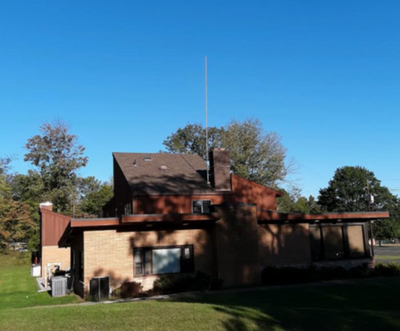
Hira’s install on the water at Six Lakes is a clean one. He mounted the 24-foot Greyline on a tilt base — the right move, because it lets him walk the antenna down for maintenance without a ladder or a crew. (Without a tilt base, many owners simply lift the pole out of its sleeve and lay it down; the 24’ weighs about 26 pounds.) Assembly ran about 20 minutes; the whole installation, under half an hour. His early verdict on 20 meters: performance has been excellent.
“Assembly took around 15 to 20 minutes. Installation was easy and completed in less than half an hour. The antenna is on a tilt mount for easy maintenance. Thus far, on the 20-meter band, performance has been excellent. Whenever I raise the flag, my neighbor stands at attention and salutes.”
— Hira, K8AXJ
That last line is the whole flagpole idea in one sentence. The neighbor sees a flagpole worth saluting. Hira sees his ticket to 160 through 6 meters. Both are correct — because the pole itself is the antenna.
Why It Goes Up Fast
Twenty-minute assembly is a design choice, not luck
A 20-minute build is not an accident of an easy day. It is what happens when an antenna has no radial field to lay, no traps to tune, no coils or stubs to place. A quarter-wave vertical needs a buried lawn of radials to work against; a vertical dipole carries its second element in the air, so the ground work disappears and the install collapses to raising one clean pole. Every splice is bolted in and test-fit at the bench before it ships, which is why the field assembly is mostly confirmation. Why no radials are required — the physics →
An honest note on scope: Hira’s report covers his early time on 20 meters. It is a first impression from a clean install, not a multi-band DXCC log — the kind of report worth more in six months, when the bands have given him a fuller picture. We will share that when it comes. What it already shows is the part that matters on day one: up fast, flying proud, and excellent where he has used it.
Read From the Source
Where waterfront operators compare notes
A waterfront QTH has real advantages. Salt water is a near-perfect ground screen that strengthens a vertical’s low-angle launch; a lake like Hira’s gives a wide-open, quiet horizon with nothing in the way. Operators trade these results constantly:
TopBand reflector archive — where waterfront and ground-quality effects on verticals get discussed in detail.
3830 score-reports reflector — operators posting real setups and results after each event.
For the openings on the bands Hira has yet to fully work, the ARRL Propagation Forecast Bulletin is the standing reference. Carried for years by Tad Cook, K7RA, a Silent Key since April 2025; the ARRL continues it in his memory.
Your Station
Up in half an hour, on the air the same day
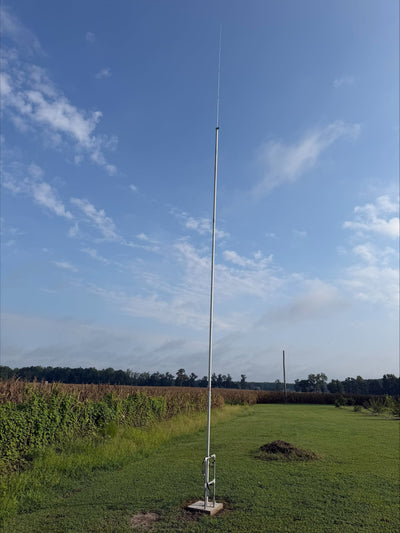
A 24-foot flagpole that ships pre-fit, raises on a tilt mount in under thirty minutes, needs no radials, and covers 160 through 6 meters with a tuner. That is what Hira put up — and the saluting neighbor came free.
Go Deeper
Best HF Vertical, No Radials — the physics →
What is a VDA? The vertical dipole explained →
The Assembly Quick Card →
New to HF? Start Here →
73, Jon KL2A · 435-200-4902
Ham Radio is fun again! Pass it on…
Read next · Getting Started
Greyline Life
How Greyline Works: The Clubhouse, The Bookshelf, The Tools, and You
Field Notes
Why Your Greyline Ships In Two Boxes
Operator Spotlight
W7TLG: Black Beauty on the Bench - An Engineer's Build
Everything on Getting Started →