Two Weeks of Voicemails, Then This: W3GF's 20-Footer and the Whip in a Florida HOA
The Signal Report · Operator Spotlight
The first half of this story is a failure, and it stays in.
Craig, W3GF, bought a 20-foot DX Flagpole in August. The box arrived without the truck — the machined top piece the flag halyard rides on. He wrote. I gave him the wrong answer. He sent a photo of the open tube. He left voicemails. Two weeks went by, which is two weeks longer than any customer should wait for a part the size of a fist.
Then, on a Wednesday in September, he called. Not about the truck.
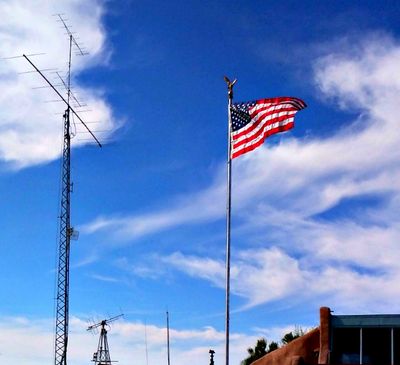
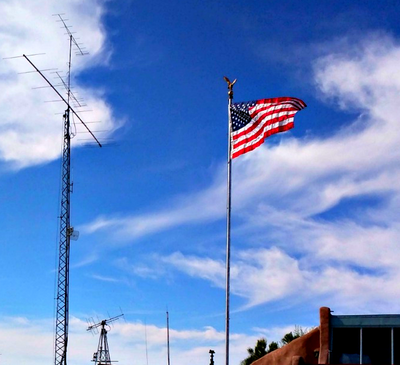
The photograph at the top of this page is the one I asked him for. Twenty-nine feet of vertical dipole against a Florida sky. The whip is the part you cannot find, and that is not an accident of the light. A two-inch pole with a nine-foot whip disappears against blue the way a full-size flag never will, which is why the flag is what the neighbors see and the antenna is what the operator hears.
What He Built
A 20-foot flagpole, a Tilt-Up Base under it, and the 9-foot DX Whip threaded into the top. That is a Skyline 29 assembled from parts — and the tilt is why he could add the whip on a weekday afternoon by himself instead of waiting for a friend with a ladder. Loosen four bolts, remove the second one down, walk it to waist height, thread the whip on, walk it back up. The Growth Ladder describes exactly this path, and Craig climbed it before the page existed.
Why the whip matters on a 20-footer: John Kraus, W8JK, established in Antennas that what governs a radiator is its length in wavelengths, not feet. Twenty feet is a substantial antenna on 20 meters and a short one on 80. Nine more feet is a small fraction of a wavelength on 10 meters and a meaningful one on 40 and 80 — so the whip pays most on the bands where a 20-footer was working hardest. Craig did not read Kraus before he threaded it on. He heard the difference and called.
The Florida Part
The large planned communities of Florida are some of the strictest antenna ground in the country, and some of the densest ham population. The flagpole is not a workaround there; for a lot of operators it is the only antenna the covenant allows. Craig's friends are asking what he put up because, from the street, he put up a flagpole. From the shack, he put up 160 through 6 meters with no radials, on a lot where a radial field would have been a violation on its own.
The Part That Is Ours
Craig's truck was one of six boxes that left our bench in a month with something missing. That is not six accidents. It is a packing process that depended on memory, and the fix is a printed checklist per product that rides with every label and gets checked before the box closes. It is on the bench now. Craig's two weeks bought that for everyone after him, and I would rather say so here than pretend the second half of this story is the only half.
If you are in one of those HOAs and wondering whether the covenant leaves you any antenna at all, the answer is usually yes, and it is usually a flagpole. Call 435-200-4902 and we will read the wording with you. Ham Radio is fun again. Pass it on.
73,
Jon KL2A
Greyline Performance — Sun Valley, Idaho
Read next · HOA
187 Countries on 35 Watts: Craig W3GF, Seven Years on a 20-Foot Vertical
Signal Lab
The Other Half of Your Antenna Has to Go Somewhere
Operator Spotlight
Margie KK7MGK: The Sun City YL Out-DXing Her Own Son