W7TLG: Black Beauty on the Bench - An Engineer's Build
Field Reports / W7TLG
Operator Field Report

Sun Valley, Idaho
The Engineer’s Commissioning
W7TLG and the Black Beauty: Measure Everything, Then Work the World
Terry W7TLG spent his career in R&D at Apple. When his black-powdercoat 24’ DX Flagpole arrived, he did what engineers do: took it apart, treated every junction, measured his chokes on a bench analyzer — and then let the log tell the story. Switzerland answered on day two — the first of six countries he had never worked in his life.

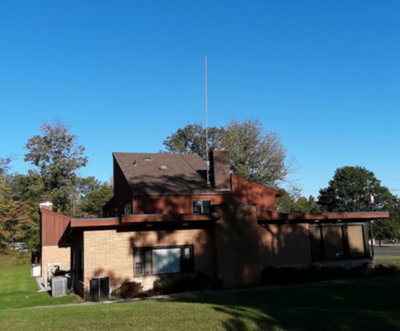
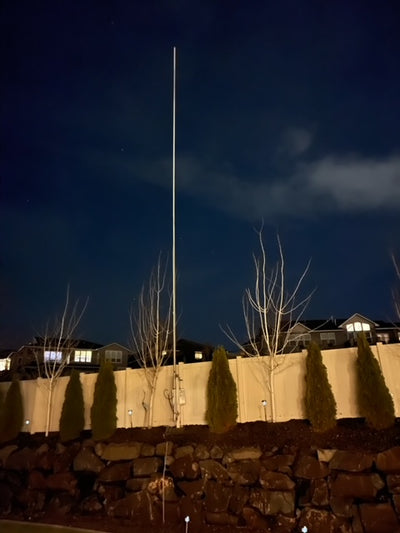
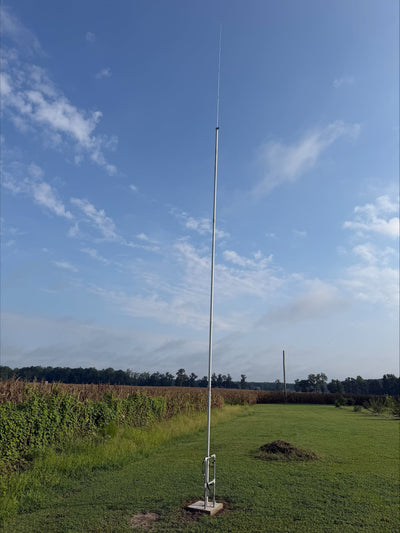
The Black Beauty: 24’ DX Flagpole in black powdercoat with the 9’ DX Whip, reading as a slim line against the treeline.
Preparation, the R&D Way
Most operators assemble an antenna. Terry commissioned one. Before the first section went vertical, he disassembled the connection points, cleaned every aluminum-to-aluminum mating surface, and treated the junctions and threads with conductive anti-oxidant compound — the same discipline our assembly guide calls for with Noalox, executed to a lab standard. He recorded the fastener torque on the way out so he could return to it on the way back in, and he plans a full fastener pass when his tilt-up base arrives and the antenna comes down for the retrofit.
Then he did the thing that makes this report worth your time: he refused to trust any choke he had not measured.
The Bench: What a Choke Actually Does
A common-mode choke has one job: keep RF on the antenna and off the outside of your feedline. The spec that matters is rejection in dB across the bands you run — and Terry put his ferrites on a NanoVNA instead of taking anyone’s word.

The snap-on bead string on the analyzer: useful suppression in the -15 to -20 dB range across HF.

His homebrew on the analyzer: better than -30 dB from 3 to 30 MHz, -36.75 dB at 14 MHz.

Inside the box: an engineer’s answer — coax on stacked toroids, weather-boxed, and 15 dB quieter than the bead string.
His finding lines up with the physics: snap-on beads are a real tool with real limits, and a wound-toroid isolator plays in a different league. It is exactly why a wound isolator belongs at the ladder-line junction — and why Terry built his own rather than wait a single day to get on the air.
In His Words
“I am ex R&D at Apple so I am OCD about details. I took the antenna bits apart and cleaned every Al-to-Al surface that needed contact… I don’t want to strip anything, but I also don’t want any motion in the wind to loosen them.”
“Got lots of good signal reports back and have worked many of the above stations, as well as China and loads of Japan. So, the DXF works.”
“I had never worked Switzerland, or Bulgaria, or Hungary, or Bosnia Herzegovina, or Austria, or Lithuania — all of which are now in my log… My WAS will finally be complete.”
Day Two: The Log Speaks

The FT8 screen, day two: HB9EFK Switzerland coming back to W7TLG in red — with Europe, Japan, and China filling the decode list.
Five watts of drive into his amplifier, and the band table read like an acceptance test: 1.07 on 40, 1.02 on 30, 1.13 on 20, 1.11 on 15, 1.09 on 12, 1.32 on 10 — and 1.21 on 6 meters, a band Terry had never had an antenna for in his life. Switzerland, China, and what he calls “loads of Japan” went in the log before the commissioning notes were even typed up.
And here is why Switzerland mattered: Terry operates from Boise, grid DN13, where the path to Europe is genuinely hard-won — a bearing that had kept whole countries out of his log for a lifetime of operating. In week one on the Black Beauty, six of them fell: Switzerland, Bulgaria, Hungary, Bosnia and Herzegovina, Austria, and Lithuania — every one a first-ever contact. And then the one that made him laugh: Massachusetts, the state that had dodged his Worked All States award for years, suddenly offered him his pick of several. His WAS is finally complete — finished from Idaho on a flagpole.
The low bands remain his open frontier — 80 sits on an impedance knife-edge at his window-line length and 160 asks more than any 33-foot radiator can easily give — and true to form, he is chasing both with an analyzer rather than a guess. That work continues, the way real engineering always does.

His full-HF sweep: R, X, and |Z| from 3 to 54 MHz — the repeating impedance structure a non-resonant vertical presents, and the reason the tuner is part of the system, not an accessory to it.
6 New Countries
never worked before — week one
First 6M
ever — at 1.21 SWR, day one
WAS Complete
Massachusetts — at last
What This Report Teaches
Terry’s bench notes carry three lessons any operator can use. Junction discipline pays: clean aluminum, anti-oxidant on the mating faces, and fasteners snug against wind — the ten minutes that decide how the antenna performs in year seven. Chokes are a measured quantity, not a vibe: dB of common-mode rejection is the spec, and more is quieter. And a non-resonant system earns its 160-6M coverage through the match — the tuner, the feedline length, and the choke are the system, not accessories to it.
The takeaway: the antenna rewards exactly the care you give it. Terry gave it R&D-grade care — and it gave him six new countries, his first 6-meter band, and the last state in his WAS, all inside a week.
The Physics Behind It
Everything Terry measured has a literature behind it. Jim Brown K9YC wrote the definitive treatment of common-mode current and ferrite chokes — the why behind every dB on that NanoVNA screen. He and the rest of the masters we build on are gathered in one place: the Authority Shelf →
From Greyline
Terry asked us for a factory torque spec, and the shop answer is simpler than a number: snug by hand tools, Noalox on the mating faces, and Loctite Blue on the lower-section stress bolts only — the rest of the connections are about RF preservation, not clamping force. For the spec-minded: the industry reference — Fastenal’s Torque-Tension Guide, stainless and non-ferrous table — puts 1/4"-20 stainless, dry, at 63.6 in-lb. Treat that as a ceiling, not a target; stainless into aluminum wants snug, not maximum. His black powdercoat came from our any-color finish program, and his tilt-up base is in the current production run. When it lands, the whole 33 feet walks down and back up — one engineer, no ladder.
Your Next Moves
More Operator Stories
WC0R: An Aerospace Engineer’s Case Study →
K3WA: Clean Sweep in CW Sweepstakes on the 20 →
K8AQM: A Weekend of DX Wonders on 160–6 →
Build your own Black Beauty
24’ DX Flagpole, 160–6M, no radials — any-color powdercoat available.
Shop the 24’ DXF →73 — Greyline Performance · Sun Valley, Idaho · 435-200-4902
Ham Radio is fun again! Pass it on…

Read next · Getting Started
Greyline Life
How Greyline Works: The Clubhouse, The Bookshelf, The Tools, and You
Field Notes
Why Your Greyline Ships In Two Boxes
Operator Spotlight
N9BGG: Back on the Air at 85 With a Greyline Flagpole
Everything on Getting Started →