Remote vs. Shack Tuner for Greyline Antennas: Which Setup Is Right?

Do I Really Need a Tuner at the Base of My Greyline Flagpole or HF Vertical Antenna?
The VDA Is Not a Monoband Antenna
The Greyline VDA (Vertical Dipole Antenna) is a broadband HF vertical designed to cover 160 through 6 meters from a single feedpoint. That means the antenna presents different impedances on different bands — some close to 50Ω, others significantly off. That’s the physics that makes the design possible, and it’s why an ATU (antenna tuning unit) matches that varying impedance to your radio and coax across all bands.
The question is not whether to use a tuner — it’s where to put it.
Remote ATU at the Base of the Antenna
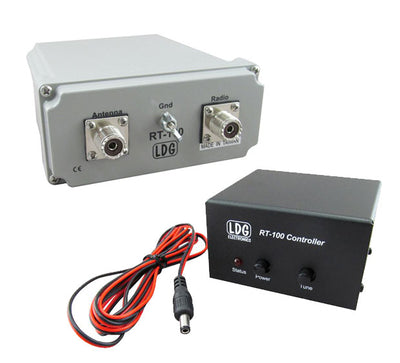
A remote ATU mounted at the antenna base — the SGC-237, LDG RT-100, or similar — matches impedance right at the feedpoint. From the tuner to the shack, the coax sees a matched 50Ω load on every band. This is the cleaner RF solution.
The LDG RT-100 handles 100W SSB but is not rated for sustained 200W FT8.
The ACOM 04AT and 06AT are designed for amplifier output and full duty cycle.
The Tuner Genius XL (4O3A / FlexRadio) is purpose-built for high-power digital.
Always verify the FT8 / digital duty cycle rating before buying — not just the SSB peak rating. The antenna itself handles legal limit at any duty cycle. The ATU is the limit.
Any coax grade works — even RG-8X on longer runs
No high-SWR voltage on long coax runs — cleaner signal
Simplifies shack: no ATU taking up desk space
Best choice for: runs over 75 feet, older coax, operators who want maximum low-band efficiency
Higher upfront cost ($150–$2,500 depending on unit)
Power-limited models common — verify duty cycle rating per the warning above
For amplifier or high-power digital operation, the ATU must be rated for the actual mode. Don't assume an SSB rating covers FT8.
Shack Tuner at the Radio End
From the Field
About half our buyers run a shack-side desktop ATU — and a meaningful portion of those are practicing RF engineers who've done the math and prefer it that way. Shack-side is not a compromise. It's a deliberate choice with real advantages, especially for operators running amplifiers or doing rapid band changes.
A shack-side ATU — internal to your radio, an outboard auto-tuner, or a manual tuner — matches impedance at the radio end. The coax between antenna and shack runs at the raw antenna impedance on each band, which can be high on some bands and frequencies. Loss in that coax run becomes a function of coax grade and length.
This is exactly how Bill (Florida HOA, 20' flagpole, IC-7610 + AL-80B) runs his station — 40' of LMR-400 from antenna to shack, Heathkit SA-2060 on the desk. Result: DXCC on 40M, 17M, 80M into Hawaii and India, 1,200+ DXCC Challenge additions. The shack tuner works.
No outdoor hardware, no DC control cable, no weatherproof enclosure
Full power handling — rated for your amplifier
Easily swapped, upgraded, or repaired without climbing the antenna
Faster band changes — tuner sits at your fingertips
Best choice for: shorter runs, larger coax, operators with amplifiers, FT8 at full power, RF engineers who like control on the desk
Loss increases with run length and frequency
Coax grade matters more — LMR-400 minimum, LMR-600 better, hardline best
Rule: if your run exceeds 75 feet, upgrade coax or move to a remote ATU. RG-8X at 100 feet on 40M loses enough signal to matter. Bigger diameter coax is cheaper than rebuilding the install.
The Coax You Choose Changes Everything — and It's Not Your Only Option
With a shack tuner, the coax carries unmatched impedance on many bands. Loss in that run matters. Coax is the most popular choice — it's familiar, it's straightforward, and it works. But it's not the only option, and depending on your install it may not be the best one.
Three feedline families to consider, ranked by loss (best to worst):
Cannot be buried in standard conduit — needs a large-diameter open-air run (6–12" PVC tube minimum).
Weather-sensitive — rain and snow detune it temporarily, but a good ATU corrects on the fly.
Best for: shack-side operators with above-ground feedline runs and a balanced ATU. Cheapest signal possible if you can route it cleanly.
Use silicone-insulated 6kV mini-split or HV wire — PVC insulation is unsuitable for HF/VHF .
Two conductors run parallel inside flex conduit, terminated to a balanced ATU at the shack.
Best for: buried installs where ladder line isn't practical and you want lower loss than coax. Requires careful selection of the wire's insulation material.
LMR-400: minimum recommended. Most installs use this.
LMR-600: better loss numbers, worth the cost on runs over 75 feet.
Heliax / hardline (7/8" to 2"): best loss numbers, used in permanent commercial installs.
Bigger diameter = less loss. Always.
RG-8X: ~1.5 dB — acceptable for short runs only
LMR-400: ~0.7 dB — minimum recommended / most of us use this
LMR-600: ~0.4 dB — better, worth the cost on long runs
Hardline: ~0.2 dB — best, use where practical
Note: Loss scales with SWR. At 3:1 SWR on RG-8X at 100 feet, actual loss can exceed 4 dB. That's nearly two S-units. Go up in coax grade before going down in tuner position.
Coming soon to The Signal Lab: Bob Zavrel W7SX has written a detailed feedline analysis paper for Greyline. Publishing as soon as final review is complete. If you want first look, drop your email on our newsletter signup.
The Issue Both Tuner Options Share
Regardless of where you put the tuner, the feedline connecting a vertical antenna to your shack can carry common mode current — RF flowing on the outside of the coax shield rather than inside it. This causes RF in the shack, noisy receive, and in extreme cases can affect your radio's performance or create RF feedback in audio circuits.
The fix is a common mode choke (line isolator or balun) at or near the antenna feedpoint. A string of snap-on ferrites on the coax, properly selected for the frequency range, also works. Bill's station uses a 1:1 coax common mode choke plus six snap-on ferrites at the house entrance — result: no RF in the shack on any band.
Recommended: Install one well-built common mode choke at the antenna feedpoint regardless of your tuner choice. One unit, properly rated for your power level, is sufficient. The Palomar Maxi-Choker 5kW or any of the Balun Designs models work well. This is the single most effective step you can take for clean receive and no shack RF.
Which Setup Is Right for You?
Coax run 50–100 feet? → Shack tuner with LMR-400 minimum. LMR-600 preferred.
Coax run over 100 feet? → Remote ATU preferred, OR LMR-600 / hardline to shack tuner.
Running FT8 at 100W+? → Verify ATU duty cycle rating. Many remote ATUs are not rated for sustained digital.
Running an amplifier? → Shack tuner is simpler and rated for full power. ATU must live after the amp.
Want lowest possible loss? → Ladder line or HV wire to a balanced shack ATU (above-ground or in conduit).
Want the cleanest plug-and-play install? → LMR-400 + remote ATU + common mode choke. Done.
Either path gets you on 160–6M. Both have been proven in the field. Choose based on your run length, power habits, and how much you enjoy fiddling.
Go Deeper in the Signal Lab
-
Feedline Physics: Coax, Loss & Line Selection →
Live loss calculator, coax comparison table, decision tree, and noise audit walkthrough. -
RF Mastery: The Physics of Balance →
Common mode current, isolation vs. balance, and why the choke position matters. -
Feedline System Kits →
Recommended parts lists for common installs — DIY guidance for kit-style builds.
Have a specific question about your run length, coax grade, or tuner choice? Call us — 435-200-4902 . We enjoy talking radio. Idaho mountain time.
73 Greyline Performance — Ham Radio is fun again!
Read next · Tuners
Signal Lab
A Match Is Not A Result: What 1:1 SWR Does And Does Not Tell You
Signal Lab
Why Your Tuner Cannot Fix a Jumping SWR
Signal Lab
LDG RT-100 Remote Tuner: Why We Bundle It