Ground Is Two Jobs Wearing One Name
Signal Lab

The Week's Lesson — No. 1
Ground Is Two Jobs Wearing One Name
Want the one-minute version? Do I need to ground my vertical? — answered →
This week one of our operators raised his antenna, worked Florida on 20 meters his first night at 100 watts — and the question he asked BEFORE that first contact was the smart one: should the mast tie to a ground rod?
Here is the answer, up front: yes, put a rod at the mast — and bond it to your house ground system. The bond is the part almost everyone skips, and the bond is the part that decides everything. Now the receipts, because "ground" is two completely different jobs wearing one name, and mixing them up is how good stations get bad advice.
Job One: RF Ground — You Do Not Need One
A quarter-wave vertical needs a ground plane — radials — because it is half an antenna looking for its other half in your lawn. A Greyline is not that animal. It is a vertical dipole: both halves of the antenna are up in the air, balanced against each other. The antenna is already complete before the ground ever gets a vote.
Which means a ground rod adds exactly nothing to how it plays. No radials in the lawn, no copper spider under the grass, no Saturday lost to a trenching shovel. The rod decision is one hundred percent about safety and zero percent about signal. If anyone tells you the rod will make you louder, smile politely and lend them a good book. We suggest two below.
Job Two: Lightning — Bond, Do Not Isolate
Lightning is where the rod earns its keep — but only if it is bonded. A rod at the antenna base gives strike energy a short path to earth right where the antenna stands. An arrester where the feedline enters the house protects the line. And then the iron rule: every ground in the system — mast rod, arrester ground, utility service ground — gets bonded together with heavy conductor into one system.
An isolated rod is not halfway safe. In a strike, two unbonded grounds sit at wildly different voltages — and that difference goes looking for a path, usually through your shack. One ground system. Everything tied to it.
Two practical notes while we are down here. First, if your station uses a remote tuner powered over the coax, make sure your arrester is the DC-pass type — it does its lightning job while letting the control voltage ride through. The blocked-DC type is the classic silent tuner-killer. Second, antenna grounding in the United States lives in National Electrical Code Article 810, and your local inspector always gets the last word. If a permit is anywhere in your picture, one phone call saves ten.
What the Bookshelf Says
We did not invent any of this, and that is the point — we point. Two authorities own this subject, and both belong on your shelf:
Ward Silver, N0AX — Grounding and Bonding for the Radio Amateur (ARRL). The modern standard. If your station has one grounding reference, make it this one.
Jim Brown, K9YC — published grounding and RFI papers. Free online, worth every page. When the internet argues about grounding, K9YC is usually the answer key.
The Archive Runs Deep
If you want to see how seriously this subject can be taken, the TopBand reflector archive holds decades of grounding debate from operators who put antennas on 160 meters for a living.
Ground for Safety. Choke for RF. Bond Everything.
That is the whole doctrine in nine words. The rod handles the storm. The bond handles the physics between grounds. And choking handles the third job people forget: keeping RF current on the antenna where it belongs instead of crawling down the shield into your shack. Every Greyline ships with snap-on ferrite choking in the feedline kit; operators running an amplifier add a dedicated line isolator. Safety, bonding, choking — three legs, one steady stool.
And our operator with the Florida contact? He asked the question before he keyed the mic. That is the order of operations of someone who will be doing this for a long, happy time.
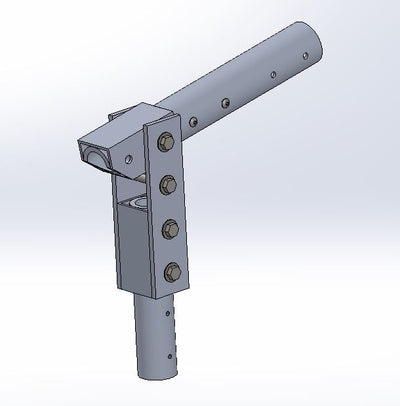
Two Ends Of One System. The 9' DX Whip on top adds aperture where every antenna is electrically shortest — it wakes up 40 and 80 meters. The Tilt-Up Base at the bottom brings the antenna to working height, one person, one bolt — and is how you reach the top to put the whip on.
The Full System — Signal Lab Curriculum
Ground & Radials: Do I Need to Ground It? · Three Grounds Walk Into a Shack · No Radials Means Two Things
Aperture & Length: What Height Should I Buy? · What Your Antenna Actually Grabs · Why Your Antenna Hates 80 Meters
The Feedpoint: Can I Use A 4:1? · Current Vs Voltage Balun
The Feedline & Tuner: Low SWR, Lost Signal · Do I Need a Tuner? · Feedline Loss Calculator
Propagation: Grey Line, Answered · The Skip Zone

Designed and Hand-Built in Sun Valley, Idaho
73 — Jon, KL2A · 435-200-4902
Ham Radio is fun again! Pass it on...
Read next · Grounding & Lightning
Signal Lab
Three Grounds Walk Into A Shack: Lightning, RF, And The Bond Between Them
Signal Lab
No Radials Vertical Antenna: Two Kinds, Only One Works
Everything on Grounding & Lightning →