What Is the Greyline? The Twilight Band That Carries DX
SIGNAL LAB

What Is the Greyline? The Twilight Band That Carries DX
Want the one-minute version? Grey line propagation, answered → This is the full Signal Lab.
Twice a day, a line crosses your station. On one side it is day, on the other night, and for a few minutes you are standing in the seam. Sailors call it twilight. Propagation people call it the terminator, or the grey line. We liked it enough to name the company after it. Here is what it is, why the low bands come alive along it, and how operators with a flagpole in the yard use those minutes.
The Physics of the Seam
During the day, the sun ionizes the D layer, the lowest slab of the ionosphere, and the D layer is an absorber. It eats 160 and 80 meter signals almost completely, which is why the low bands are quiet at noon. At night the D layer recombines and disappears, while the higher F layer, the mirror that actually bends your signal back to Earth, lingers on.
Along the terminator you get the handoff moment: D layer absorption collapsing while F layer refraction still holds strong. John Devoldere, ON4UN, devotes a portion of Low-Band DXing (ARRL) to exactly this window, and it remains the standard reference on the subject. Signals launched along the twilight line travel through this low-loss corridor, sometimes bending around the planet in ways daytime physics forbids. Two stations that both sit in twilight, even ten thousand miles apart, can share a path that exists for minutes and then closes like a door.
The greyline is not a trick. It is the brief daily truce between the layer that absorbs your signal and the layer that carries it.
What It Sounds Like From a Backyard
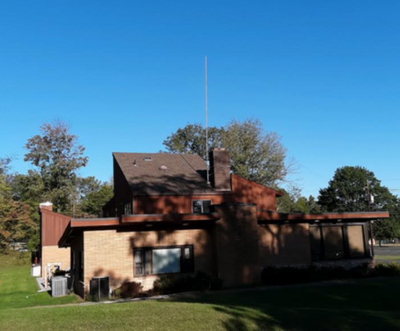
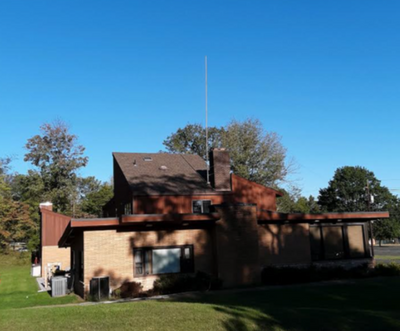
This is not tower-owner physics. Bill, K3WA, runs a 24-foot DX Flagpole on an HOA lot and worked 61 stations across 23 sections on 160 meters, the band most operators say is impossible without acreage. The low bands reward the operator who is on the air at sunrise and sunset, when the seam sweeps through, and the antenna that is standing in the yard every one of those mornings beats the bigger one that never got permission to exist.
Jose, CT1BOH, one of the great living students of propagation, has spent a career reading these openings in contest conditions. The lesson from operators at his level is consistent: the calendar and the clock matter as much as the hardware. Know when your terminator passes, and be transmitting when it does. The TopBand reflector archives hold decades of sunrise-peak reports that say the same thing.
Working Your Own Greyline
Three habits, no new hardware required. First, learn your twilight times and treat the 30 minutes around local sunrise and sunset as appointment radio, especially October through March when low-band nights are long. Second, aim along the line: at your sunrise, stations at their sunset are the natural partners, which usually means look west at dawn and east at dusk. Third, watch the map. The Greyline Clubhouse carries a live terminator and space-weather pane, patterned after the reference work of CT1BOH, so you can see the seam approaching your county in real time.
Why We Took the Name
A company built for operators on restricted lots could not promise towers. It could promise this: an antenna standing in the yard every single twilight, ready for the two windows a day when the planet itself does the amplifying. The HOA sees a flagpole. The terminator sees a station.
Watch your greyline sweep in, live — The Clubhouse DX Console →
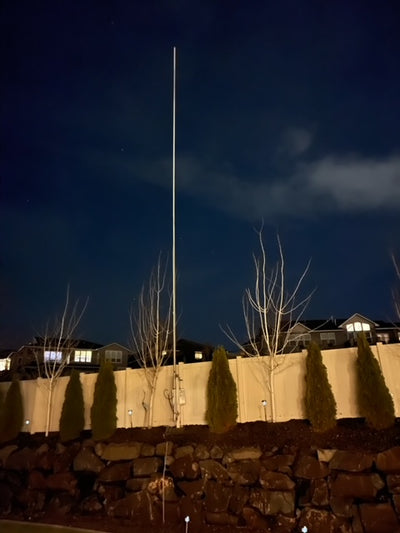
Two Ends Of One System. The 9' DX Whip on top adds aperture where every antenna is electrically shortest — it wakes up 40 and 80 meters, exactly the bands the greyline rewards. The Tilt-Up Base at the bottom brings the antenna to working height, one person, one bolt — and is how you reach the top to put the whip on.
The Full System — Signal Lab Curriculum
Propagation: Grey Line, Answered · The Skip Zone
Aperture & Length: What Your Antenna Actually Grabs · Why Your Antenna Hates 80 Meters · What Height Should I Buy?
The Feedpoint: Current Balun Vs Voltage Balun · Can I Use A 4:1?
The Feedline & Tuner: Low SWR, Lost Signal · Do I Need a Tuner? · Feedline Loss Calculator
Ground & Radials: No Radials Means Two Things · Do I Need to Ground It?
By Email: Get the Field Guide — the Signal Lab in your inbox

Designed and Hand-Built in Sun Valley, Idaho
73 — Jon, KL2A · 435-200-4902
Ham Radio is fun again! Pass it on...
Read next · Low Bands
Signal Lab
Why Your Antenna Hates 80 Meters
Operator Spotlight
K3WA Works 160M Contests from HOA on 24' Flagpole | Greyline
Field Notes
Low Band & WARC Primer: 160-12M DX as Cycle 25 Peaks