


Greyline Upgrades · DXF and DXV Compatible
The 4' Extension — Four More Feet, Two Places to Put Them.
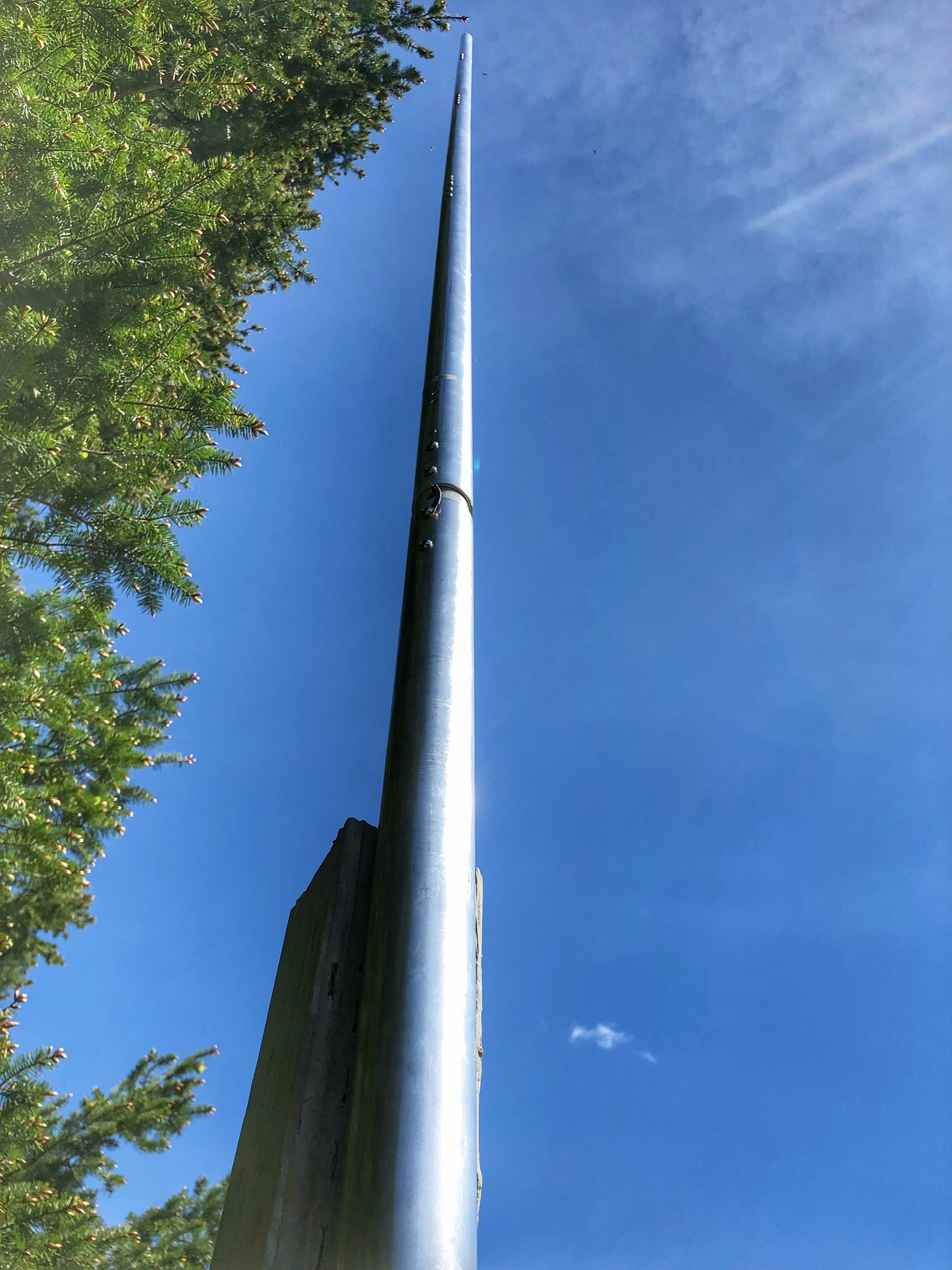
One 4-foot section of the same 2-inch aluminum, the same splice, the same stainless hardware as the rest of your antenna. It still works every band, 160 through 6. Where you put it decides what it does.
Up Top — More Radiator
Takes your Greyline up one step: 12 to 16, 16 to 20, 20 to 24, 24 to 28. More length where 40, 80 and 160 reward it most; the bonus gain moves down the dial. Installs just below the top section.
Below the Feedpoint — The 4' Image Lift
Goes between the ground sleeve and the lower insulator. The lower half of the dipole becomes eight feet, the whole antenna rises four feet, and your upper radiator stays exactly as long as you built it. Needs the Image Lift Kit (11' ladder line + 3 spacers).
Why Give the Antenna More Sky?
Every vertical works together with its mirror image in the ground — Kraus and Zavrel both draw it, the other half of the antenna you cannot see. A Greyline carries its own return current, so that image is a bonus rather than a requirement, which is why it works the same on sand, rock, clay and rooftops. Lifting the feedpoint four feet simply gives the low bands a little more room to work, and the upper radiator — the length we protect on 28-footers and down, up to about five-eighths of a wave on the highest band you want to keep — is untouched. A 33 up with 8 down is 41 feet of antenna from a 33-foot footprint. Every Greyline can be built this way. The image antenna, explained →
What ships how: the extension tubing ships free, like every antenna part. The Image Lift Kit is eleven feet of 450-ohm line and three spacers in a padded envelope; it ships on its own at carrier cost, or ride it free in the box by ordering it with an antenna and writing “below the feedpoint” in the order notes.
Add the Image Lift Kit — $29 →In the Kit
One 4-foot, 2-inch section and its transition splice, with matching stainless hardware. Ships bagged and boxed, couplers already bolted on.
What Four Feet Buys Up Top
In NEC modeling over average ground, going from 20 to 24 feet lifts 40 meters by about half a decibel and moves the strongest bonus from 10 meters toward 12, with more gain on 30 through 15. Going from 16 to 20 is a similar step. One well-known DXer called his 20-to-24 upgrade night and day; others notice it less. Physics sets the gain; propagation decides how often you hear it.
See every combination, band by band, in the VDA Optimizer →
From the Reviews — Ten Owners, 4.9 of 5
The extension is the most-reviewed upgrade we make. What ten verified owners say four feet did:
“My first week after adding the 4 foot extension (a super easy job with the tilt-over!), I logged RI1FJL on 15m and P29YY on 17m, and discovered I could now make QSOs on 80 meters. I hadn't made a QSO on 80 meters since I moved into this HOA community 21 years ago!”
— Tom, N3EQF · Florida · 24 ft DX Flagpole plus extension · “Size Does Matter!”
“I thought I was getting great reception from my end feed wire. I installed the 24' vertical with the remote tuner and connected it to my Icom 7300. What a night and day difference! My radio came alive. I've already connected with Australia, Japan, and all over.”
— Bill · Arkansas · 24 ft with extension · Verified Owner
“I have two Greyline antennas both with 4 foot extensions on them. I have a 24 foot with a 4 foot extension making 28 and a 20 foot with a 4 foot extension making 24. I have used both of these antennas and made contacts all over the world.”
— Marvin · two antennas, two extensions · Verified Owner
“I was impressed with the quality of the antenna tubing used. It's not the normal aluminum used by the other manufacturers, but a precision machined tubing. It fit together tightly with the thick fiberglass insulating sections.”
— Christopher · “A positive upgrade” · Verified Owner
“I find that the added 4 feet makes a difference, along with the 9' whip and tilt base. Signals are stronger on receive, and my transmit reach appears to have extended based on signal reports. Still adding many DX contacts to the log!”
— Chris, K1LDO · North Carolina · 249 DXCC entities and counting · Verified Owner
All reviews are collected and verified by Judge.me; the full list is at the bottom of this page. Across the whole Greyline line: 69 verified reviews, 4.87 average.
Before You Order — Your Pole's Year
Greylines built in 2021 and earlier used a slightly different tube wall. If yours is one of them, it needs a fit splice so the extension seats properly — we have them. Put your antenna's year in the order notes, or call 435-200-4902, and we will send the right parts the first time.
Wind Ratings Follow the New Height
Once extended, your antenna carries the ASCE 7-10 rating of its new overall height — flag up / flag down: 16 ft 75/115, 20 ft 60/90, 24 ft 50/70, 28 ft 35/55 MPH — whether the four feet went up top or below the feedpoint. Lower the flag when weather threatens. Extending a 28-footer up top takes you past our standard range; call before you order that one.
Pair It With
The Tilt-Up Base
Add height without a ladder: walk the pole down to waist height, add the section, and walk it back up alone. Fourteen seconds shows it →
View Tilt Base →Or Go Further: The 9' Whip
Nine feet of adjustable upper radiator on top of any Greyline, strongest on 17 meters on the Skylines.
View the Whip →From the Field
“Going from the 20 ft to the 24 ft antenna made a very big difference. Now I can run in most contests both domestic and DX when condx are decent on 40 thru 10.”
— Bill · K3WA · PVRC President · North Carolina HOA
Gain figures: NEC modeling over average ground. Further reading on the Bookshelf. Every install document is on Documents & Forms.
Questions? Call 435-200-4902. Ham Radio is fun again! Pass it on… 73, Jon KL2A