He Walked It Up Alone, Then Worked Franz Josef Land
Signal Lab

Operator Spotlight · K1LDO · Eastern North Carolina
He Walked It Up Alone, Then Worked Franz Josef Land
Update, September 2026 · Two Months Taller
We asked Chris the question every upgrade should have to answer: now that the extension, the whip, and the tilt base have been up for a season, was the added aperture worth it? He answered in a verified review titled “Aperture makes a difference.”
“I find that the added 4 feet makes a difference, along with the 9’ whip and tilt base. Signals are stronger on receive, and my transmit reach appears to have extended based on signal reports. Still adding many DX contacts to the log!”
— Chris, K1LDO · verified review, 4’ Vertical Extension
Notice what he measured it by: stronger signals on receive, and the other stations’ reports on transmit. Not a meter reading at his end — the only honest scoreboard there is. More aperture captures more of the passing wavefront on receive and launches more on transmit, and the gain is largest where the antenna was shortest. That is the whole case for the top of the pole, and Chris’s log is still growing on it.
Tom, N3EQF, ran the same experiment from an HOA lot this month and got his first 80-meter contacts in 21 years: Eighty Meters After Twenty-One Years →
Chris Diederich, K1LDO, had a 20 ft vertical standing in an open North Carolina field, already topped with the 9 ft DX Whip. This summer he added a 4 ft extension and a tilt adapter — which builds the Skyline 33 configuration, and with the tilt base underneath it his antenna stands a full 34 feet. Then, with no crew and no crane, he walked the whole thing into the sky by himself. Since then: Franz Josef Land, Turkey, Greenland, and Western Australia from ten thousand miles away.

Ground to whip tip, 34 feet of it — the tilt base adds better than a foot of its own. No flag on this one. Chris runs it as a vertical, proudly.
One Person, One Sleeve, One Walk
This is the sentence the Tilt-Up Base exists to make possible, and Chris wrote it himself without being asked.
"I raised it by myself. In fact, after I assembled the extension and tilt adapter, I placed the adapter in the tilt position, put the short section into the ground sleeve and walked the antenna up."
— Chris, K1LDO · Eastern North Carolina
Assemble on the ground, where your hands and your eyes both work. Set the adapter to tilt. Short section into the sleeve. Then walk it up, the pole rising as you advance, geometry doing the lifting your back would otherwise do. It was not frictionless — one insulator refused to seat, and it came loose eventually with rags, a vise, and channel locks, which is the kind of detail marketing copy leaves out and operators need to hear. The point stands: the operator who can raise his own antenna is the operator who will lower it before a storm, service it when it needs service, and try things.
The Base Underneath It
Look at what Chris did below ground, because this is a man who builds things properly. A 3 ft hole with the sleeve set in 250 pounds of concrete. A 16 by 16 by 4 inch pad poured on top. And then the detail that gives him away: a 3/4 inch swept 90 degree conduit run through the concrete and down into the earth, aimed at the shack, so the LMR-400 leaves the base underground and never crosses the grass. No coax to mow around. No coax to trip on. No coax baking in the sun. That conduit took an afternoon and it will pay him back for twenty years.

Sleeve, concrete, tilt adapter, feedpoint. The unglamorous half hour that decides the next twenty years.
First Contact: San Diego, Then Turkey And Greenland
The first QSO after the walk-up was San Diego during the North American QSO Party, on 20 meters, a solid 59 — as were, in his words, the myriad other NAQP contacts that evening. Then the evening delivered its closing argument: Turkey and northwest Greenland on 20 meter phone, both 59 both ways. That is a first night. Most antennas do not get a first night like that.
Franz Josef Land, And The One That Got Away First
RI1FJL is not a casual entity. Franz Josef Land sits deep in the Russian Arctic, and working it means putting a signal up a polar path that is closed more often than it is open. Chris got there on 15 meter FT8 — but not on the first try. Days earlier he had exchanged signal reports with them and could not close the contact, conditions collapsing before the final 73. He had not even had the DXpedition on his radar and had to go research what he was hearing; at that point they were showing as maritime mobile, which may well have been part of the trouble.
He went back. He got it. That is the whole hobby in three sentences.
Ten Thousand Miles, Repeatedly
Australia, New Zealand, China, and Japan — numerous times, not as flukes. Western Australia is roughly ten thousand miles from his QTH. Part of that is the antenna and part of it is the ground it stands on: Chris has 76 acres, 45 of them open field, which means a vertical with an unobstructed low takeoff angle in every direction that matters. A vertical wants the horizon, and his horizon goes on for a while.
"No HOA — I'm the HOA around here Hi Hi!!"
— Chris, K1LDO, on 76 acres in eastern North Carolina
248 Entities And Still Hunting
Chris is up to 248 DXCC entities — eight more since this story first ran, at 240. He hunts and pounces anything new, and has been working on Cambodia, Laos, and the Seychelles. He is retired — twice, he notes — which puts him at the radio during the daylight hours when those particular paths open. There are worse retirement plans.
The Build
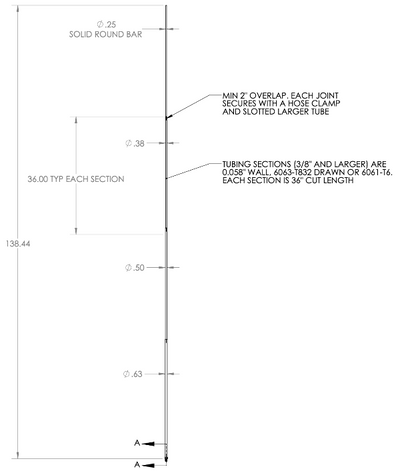
- Antenna: 20 ft DX Vertical, already running the 9 ft DX Whip; a 4 ft extension and tilt adapter added this summer — the Skyline 33 configuration, standing 34 ft with the tilt base beneath it. No flag
- Base: 3 ft hole, sleeve set in 250 lb of concrete, 16 x 16 x 4 in pad, 3/4 in swept 90 degree conduit through the pour and into the earth toward the shack
- Feed: 75 ft LMR-400 from the feedpoint to a lightning arrestor, then 15 ft LMR-400 to an LDG AT-1000ProII desktop autotuner. Five snap-on ferrites at the feedpoint end, and a noise filter and choke between the tuner and the radio
- Station: Yaesu FTDX101MP, no amplifier. An IC-7300 rests on the bench, retired from duty since the 101 arrived
- Ground: 76 acres, 45 of it open field. Low takeoff angle in every direction

The top nine feet. Aperture you can see, on bands you can hear.
A Feed System Done Right, And What It Still Will Not Do
Chris runs his tuner in the shack, which means his coax carries an unmatched line from the antenna and a matched line to the radio. His choking follows exactly the rule that arrangement calls for: five snap-on ferrites at the feedpoint end of the long run, stopping common-mode current where the antenna excites the shield, and a noise filter and choke between the tuner and the radio, keeping the shack clean. Both ends of the line, nothing hanging in the middle. If you want the argument behind that, with W7EL, K9YC, W2DU, and W7SX carrying it: Where The Choke Goes →
Now the part most companies leave out. Chris keeps an off-center-fed dipole in the air with its feedpoint at 45 feet, and he is direct about why: the Greyline will not tune 160 for him, so the wire fills that gap. He is equally direct about the other half — the dipole is noisier than the vertical, which he attributes to the inherent physics of that arrangement, and he is right to.
We publish that because it is true and because the physics is worth understanding. Radiation resistance falls with the square of an antenna's length in wavelengths — that is Kraus — and on 160 meters a 34 ft radiator is electrically tiny. Every foot of aperture is fighting uphill down there, and where the match finally settles depends on your tuner, your feedline, and your ground. Jakob in Iceland gets reasonable results on 160 from 28 feet with a different feed arrangement entirely. Chris does not, with his. Both statements are true, and an operator who tells you only the first one is selling you something.
The Two Ends Of Chris's System
The whip goes on top and buys aperture where the low bands need it most. The Tilt-Up Base goes at the bottom and is how one person reaches the top — and lowers it again when weather comes. Two ends of one system, and Chris runs both. The 4 ft extension carried his 20-footer up to the Skyline 33 configuration without a second antenna, and the tilt base added better than a foot on top of that.
More Operator Stories
He Would Not Give Up His Flag Light · the same configuration run the other way — W7MNE flies the flag, keeps the light lit, and put the whip above both.
Under The Aurora: TF1CB Works The World From An Icelandic Shore · Japan, Kuwait, and Indonesia on day one.
Your RF System, End To End · the whole feed side on one page.
Chase your own Arctic path tonight — live cluster, RBN, and band conditions run free on our DX Console, where Greyline owners glow gold. K1LDO is one of them.

Hand-built antennas from Sun Valley, Idaho. Wondering whether you could raise one alone? Call 435-200-4902 — an operator answers.
73, Jon KL2A
Ham Radio is fun again! Pass it on... 73
Read next · Skyline & Whip
Operator Spotlight
Eighty Meters After Twenty-One Years
Operator Spotlight
Two Weeks of Voicemails, Then This: W3GF's 20-Footer and the Whip in a Florida HOA
Signal Lab
Nine Feet You Have Not Used Yet: What the Whip Actually Buys
Everything on Skyline & Whip →