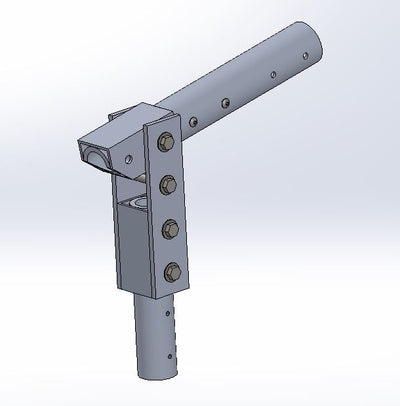
Every Greyline Has a Tilt Now: The 2" Tilt-Up Base and the 2.25" XL

Signal Lab
Every Greyline Has a Tilt Now: The 2" Tilt-Up Base and the 2.25" XL
Announcing two tilt-up bases -- one for every Greyline HF vertical antenna ever built. The Tilt-Up Base for the current 2-inch line, 12 to 28 feet. And the new XL Tilt-Up Base, built from the ground up for the original 2.25-inch antennas. Both on the shelf, both buy-now, real build dates.
Watch it work: Tom, N3EQF, raises his 24-footer alone on the Tilt-Up Base. Fourteen seconds, one person, one bolt.
The Physics of a Tilt
The base of a vertical carries the bending moment of the entire pole in every gust. It is where poles give way, where hardware loosens first, and where the fiberglass insulator does its hardest work. A tilt-up base puts that joint on a pivot engineered to be the base itself -- and turns the whole antenna into something one person walks down to waist height. The maintenance that keeps an antenna standing -- re-torque, hardware swaps, insulator checks, the flag, the whip -- gets done on the ground in minutes. A ladder is the reason it usually does not.
That physics is also why the XL had to be its own part. The standard Tilt-Up Base is built for the current 2.00-inch line; machining it to fit a 2.25-inch pole would leave a thinner splice carrying a taller, heavier antenna with more wind load -- a weak link at the bottom of the one structure that must not have one. So the XL uses heavier square tube, heavier flat bar, and longer pivot bolts, with the same one-person tilt-over mechanism.
Which Tilt Is Yours
Tilt-Up Base -- 2-inch line, every current Greyline 12 to 28 feet. $349, shipping included. Buy now ->
XL Tilt-Up Base -- the original 2.25-inch antennas. Introductory $400 for original owners through September 10, 2026; $479 after. Buy now ->
Not sure which era your antenna is? Measure the outside diameter of any section: 2.00 inches is the current line, 2.25 inches is the original. The assembly documents carry both manuals.
What Changes at Your Station
It is checkup season. With a tilt: sight the pole, read the hardware, swap what rusted, dress the flag, walk it back up -- ten minutes. One owner is 77 and raises his 33-footer alone; his wife slides the bolt while he steadies the pole, both standing on level ground. Another bought it because his body had earned the right to skip ladders. The Fall Checkup is the five-minute inspection; the tilt is what makes it five minutes.
From the bench: stainless hardware kits are on the shelf now, replacement base sections ship same-day, and Greyline Club members go to the front of the line on every replacement order. Hand-built in Sun Valley, Idaho; every order gets a real build date.
Once You Can Reach The Top
You already know the 9' DX Whip and the 4' Extension -- the tilt is how you reach the top to add them. The whip adds dBi on the middle bands and brings 40 and 80 alive -- gain that rises to the 5/8-wave point the whip is built to (John Kraus, W8JK: radiation resistance falls with the square of length in wavelengths, so the feet you add at the top pay their largest dividend on the low bands). See what the height buys on the dBi Gain Optimizer, and check your run on the Feedline Loss Calculator. All of it lives under one roof on Accessories & Hardware.
More Operator Stories
He Would Not Give Up His Flag Light -- 77, and he raises it himself. The One-Man Flagpole -- KQ4DEP turned storm prep into a solo job. The field reports live on The Signal Report.
Ham Radio is fun again! Pass it on...
73,
Jon KL2A
Greyline Performance -- Sun Valley, Idaho
435-200-4902
Read next · Tilt-Up Base
Every Station He Can Hear: Bernie KB6FRD's 24-Footer Under a Nevada Sky
Operator Spotlight
He Would Not Give Up His Flag Light
Operator Spotlight
He Walked It Up Alone, Then Worked Franz Josef Land