
Antenna Selection Guide | Greyline Performance
Antenna Selection Guide · All Operators
Which Greyline Antenna Is Right for You?
Five heights. Two form factors. One RF architecture. Every Greyline VDA (Vertical Dipole Antenna) covers 160 through 6 meters from a single feedpoint. The question isn't which bands you want — it's which antenna fits your installation environment, your wind zone, and your priorities for low-band performance. This guide answers that in four steps.
Step 1 — Choose Your Form Factor
DX Flagpole — HOA & Residential
Presents as an Embassy Grade residential flagpole. Flies a full-size flag. HOA compliant, XYL approved, completely stealthy — nothing visible identifies it as an amateur radio antenna. The right choice for restricted lots, HOA communities, and operators who want a permanent property asset that improves curb appeal.
Available: 12, 16, 20, 24, 28 ft
DX Vertical — Unrestricted & Field
Clean vertical profile for unrestricted installations — rooftop, ground post, tower mount, rapid-deploy EmComm base. No disguise needed. Same VDA RF architecture as the flagpole line. The right choice for operators with no HOA restrictions, rooftop deployments, POTA operations, and agency/EOC installations.
Available: 12, 16, 20, 24, 28 ft
Step 2 — Choose Your Height
All models cover 160 through 6 meters. Height determines efficiency — particularly on the low bands where more physical length means more aperture relative to wavelength. A taller antenna is more efficient on 40, 80, and 160 meters. A shorter antenna carries a higher wind rating. Choose the tallest model your wind environment supports.
Wind ratings are ASCE 7-10 structural engineering values — not catalog estimates. DX Flagpole models have separate flag-up and flag-down ratings. Federal practice is to lower the flag when weather threatens. See individual product pages for full flag-up/flag-down specifications.
The pattern advantage — why taller isn't always better: As height increases, low-angle radiation improves and low-band efficiency increases — up to a point. An antenna that exceeds 5/8-wave on the high bands begins to deteriorate in pattern. The 43-foot vertical is a well-known example: excellent on 80 and 40 meters, but shooting signal skyward on 15 and 10 meters. Greyline's 12–28 foot range is specifically designed to stay on the right side of that line across all bands.

Key: 80M red · 40M blue · 20M green · 15M orange. Notice how the 43' vertical pattern deteriorates on 15M — signal goes up, not out.
Step 3 — The VDA Advantage
Every Greyline antenna uses the VDA (Vertical Dipole Antenna) architecture — an off-center-fed vertical dipole with a balanced feedpoint. Return current flows through the lower element, not buried radials. The 2" pole footprint lets you place the antenna in the quietest spot on your property — away from neighbor noise sources, not running toward them.
A traditional quarter-wave vertical feeds at a current maximum at the base — maximum ground coupling, maximum sensitivity to soil conductivity, and maximum incentive to install a proper radial field. Getting radials right is genuine engineering work with real instruments: soil conductivity measurement, correct radial length and spacing, and real-world iteration. Most operators compromise. The VDA sidesteps that entire problem by design — not by claiming zero ground interaction, but by removing the antenna's dependency on it.
One number to ask any competitor: outer diameter.
Wind load is a direct function of projected area — height × outer diameter. Greyline publishes OD: 2 inches, full length, the smallest of any full-HF-coverage antenna. Every wind rating is derived from ASCE 7-10 structural engineering methodology. Ask any competitor for the same two data points. If they can't provide them, factor that into your decision. See the full comparison →
Smart
Balanced VDA feedpoint. Significantly reduced ground coupling compared to radial-dependent designs. Lower noise floor. Consistent performance across soil types and mounting surfaces. 160–6M from a single feedpoint with a compatible ATU.
Strong
6061-T6 aircraft-grade aluminum. Graduated wall — 0.125" lower 30% where bending stress peaks, 0.065" upper 70% to reduce mass at height. 2" OD throughout. 316 marine-grade stainless hardware. ASCE 7-10 engineered wind ratings. 100% duty-cycle rated. 7-Year Performance Guarantee. Made in Sun Valley, Idaho, USA.
Elegant
Single pole. Single feedline. No radial fields, no guy wires, no visible RF infrastructure. Flagpole versions present as residential flagpoles — HOA compliant, XYL approved. Mount anywhere: ground sleeve, rooftop, deck, dock, tower, or tilt-mount.
Step 4 — What's Included
Every DX Flagpole Includes
❖ DX Flagpole Antenna — VDA design, 160–6M
❖ RF Choke & Precision Feedline Hardware
❖ Flag Kit Hardware — premium USA-made
❖ Ground Sleeve Kit — in-ground or structural mount
❖ Assembly Manual & Tuning Guide
❖ HOA Architectural Brief & Property Integrity Letter
❖ 7-Year Performance Guarantee
Every DX Vertical Includes
❖ DX Vertical Antenna — VDA design, 160–6M
❖ RF Choke & Precision Feedline Hardware
❖ Ground Sleeve Kit — in-ground or structural mount
❖ Assembly Manual & Tuning Guide
❖ 7-Year Performance Guarantee
Add ATU: Shop antenna + LDG RT-100 bundle for a complete, pre-matched system.
From the Field
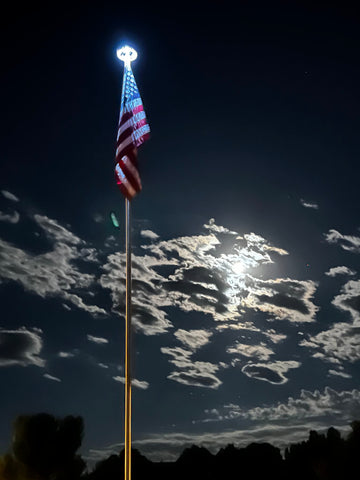
“24' HOA DX Flagpole under a Wyoming sky — 500+ worldwide contacts logged.” — Jeff, N7TBU

“I work Africa and Europe with just 60W on FT8.” — Bill, WJ8B
Not sure where to put it? Call or email us your address or Google Earth coordinates for a free site review. We'll identify the best placement on your property for signal, aesthetics, and structural considerations. No obligation. We've been doing this for a decade. Contact → · 435-200-4902