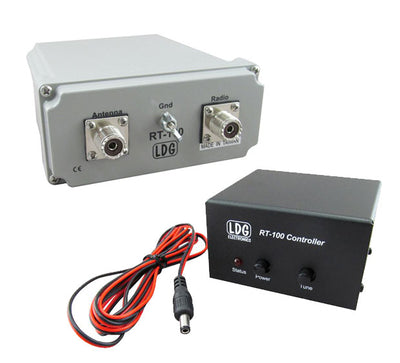
LDG RT-100 Remote Tuner: Why We Bundle It
SIGNAL LAB

LDG RT-100 Remote Tuner: Why We Bundle It
Short answer: the RT-100 is the easy, affordable way to get every band going fast. It is a 125-watt weatherproof remote tuner that lives at the base of the antenna, takes its power over the coax, and matches 160 through 6 meters at the push of the radio's tune button. It is not the only choice — almost any decent-size tuner works with a Greyline — but for a starter station it is hard to beat for price and simplicity. Here is the reasoning, so you can judge it yourself.
Why This Antenna Wants A Tuner At All
A single-band antenna can be cut to resonance and left alone. A 160-6M vertical dipole cannot: the same physical length is electrically short on 80, near a wavelength on 20, and long on 10, so the feedpoint impedance swings widely from band to band. That is not a flaw — it is the price of every band from one pole — but it means something has to transform the match. The only question is where that something lives, and there are two right answers.
The Case For The Base
A remote tuner at the base closes the mismatch at the antenna, so the feedline runs matched the whole way home. That makes the cable's job easy, which helps most on long runs. Walter Maxwell, W2DU, laid out the feedline-loss math in Reflections. We wrote the full teach here: Indoor vs Remote Antenna Tuner →
The Case For The Shack — Also Right
Plenty of fine stations run the tuner indoors: the one already in your radio, the trusted box on the desk, the high-power unit an amplifier demands. It sits at your hand, changes bands in a moment, and keeps the electronics out of the weather. Because the mismatch rides the feedline, the feedline's quality matters: run the numbers in the Feedline Loss Calculator and feed the antenna with ladder line or low-loss coax. Either road works.
Remote tuner: the match happens at the antenna. Shack tuner: the feedline carries the mismatch, so give it a good feedline. Two right answers.
What The RT-100 Actually Is
The LDG RT-100 is a 125-watt autotuner in a weatherproof housing, fed and powered through the coax by its indoor bias tee — no separate control cable, no wall wart at the pole. It remembers its matches, so returning to a band is near-instant. Its matching range covers the swings a multiband vertical dipole presents across 160-6M. The Greyline feed kit — ladder line, snap-on ferrite choking, the adapter to your coax, and spacers — ships in every box.
Where It Stops — And Other Good Tuners
The RT-100 is rated 125 watts. Barefoot operation — where most FT8, CW, and everyday SSB happens — it handles with margin. Running an amplifier, or already own a tuner you trust? Almost any decent-size tuner will match a Greyline, remote or desk. Bill, K3WA, runs his 24-foot DX Flagpole in contests at legal limit with his own high-power arrangement. The physics of the pole does not change; only the box does.
Why The Bundle
One order, one price lower than the two pieces bought separately, and a starter station that gets every band going fast. That is the whole pitch.
See the Antenna + Tuner Systems →
Two Ends Of One System. The 9' DX Whip on top adds aperture where every antenna is electrically shortest — it wakes up 40 and 80 meters. The Tilt-Up Base at the bottom brings the antenna to working height, one person, one bolt — and is how you reach the top to put the whip on.
The Full System — Signal Lab Curriculum
Aperture & Length: What Your Antenna Actually Grabs · Why Your Antenna Hates 80 Meters
The Feedpoint: Current Balun Vs Voltage Balun · Can I Use A 4:1?
The Feedline & Tuner: Do I Need a Tuner? · Indoor vs Remote ATU · Feedline Loss Calculator
Ground & Radials: No Radials Means Two Things · Ground Is Two Jobs
Designed and Hand-Built in the USA
73 — Jon, KL2A · 435-200-4902
Ham Radio is fun again! Pass it on...
Read next · Tuners
Signal Lab
A Match Is Not A Result: What 1:1 SWR Does And Does Not Tell You
Signal Lab
Why Your Tuner Cannot Fix a Jumping SWR
Signal Lab
Can I Use A 4:1 Balun On A Vertical Dipole?