Ten Feet from Salt Water: K2DJN's Maine Granite DX Post

Operator Spotlight · K2DJN
Ten feet from salt water: a naval architect, a custom tilt base, and Maine ice that met its match.
Corning Townsend, K2DJN, designs boats for a living. At 85, he put a Greyline flagpole on a granite ledge where the tide comes within ten feet of the feedpoint, engineered his own tilt mount, and got on the air the real way — with a struggle, a reset, and then a subject line that read “Up and DXing.”

Ten feet from salt water. Maine granite, pewter sky, and the takeoff you can see.
In Corning’s Words
“After one day, I’d say it is a great solution for hams that have HOA issues, no chance of radials, limited area for long wire. The build quality is superb.”
— Corning Townsend, K2DJN, first day on the air
The man behind the pole
Corning designs boats. Real ones — naval architecture runs in the family, and his grandson just graduated from the University of Michigan in the same discipline, which tells you everything about how seriously this household takes engineering. When Corning titled one of his emails to us “Antenna easily put up with 1.5 or maybe just one person under 85 years old,” we knew we were dealing with a man who measures things truthfully, including himself.
He lives where Maine meets the sea: good news, ten feet from salt water; complicating news, sea level, with trees and the house shouldering the horizon from northwest to northeast. And Maine, as he put it in four words that should be on our brochure: “Maine gets a lot of ice.” A guyed wire antenna in that climate is a seasonal sculpture. A flagpole is forever.
The whole arc
We tell the whole arc in these spotlights, not just the sunset. Corning was new to the feedline question, and his install was not smooth. He started with 450-ohm ladder line, run above ground — the low-loss purist’s choice — and in a Maine winter, snow and ice on an aerial ladder line became a real problem. There were frustrating days, and he told us so in exactly those words, and he was right to. We owed him better first answers than he got, and we said that too. That part of the story is here.
What followed was a proper reset: the right parts, the right sequence, straight talk about his options — and he moved to LMR-600 coax, buried, out of the weather. Both feedlines are good choices; they solve different problems. Ladder line wins on loss on an aerial run; buried low-loss coax wins when snow and ice own the air. Some owners even bury balanced twisted pair in metallic conduit to get a little of both. Which one loses less on your run is a calculation, not an opinion — the Feedline Loss Calculator will compare them for your length and bands in thirty seconds.
Then one May afternoon the subject line changed to “Up and DXing.” He also noted, truthfully, that a complete high-power system is real money compared to a wire in a tree, unless you’re restricted as above — and we quote that too, because it’s true, and because “restricted as above” describes most of the operators we build for. Every feedline option, with the physics, lives on our Feedline Systems page.
The Build
K2DJN’s saltwater post, end to end.
Antenna: Greyline 20’ DX Flagpole with the 9’ DX Whip — 29 feet, the Skyline 29 configuration (160M–6M, single feedpoint, no radials).
Feed: LMR-600 low-loss coax, buried — after a first chapter on above-ground 450-ohm ladder line that met the Maine winter.
Shack: Icom IC-7600, ACOM 1000 amplifier, kilowatt-class LDG tuner.
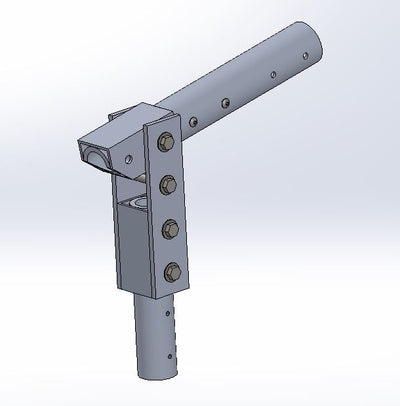
Base: Custom tilt-up mount, designed and fabricated by Corning himself.
QTH: Maine tidal granite — ten feet from salt water, sea level, saltwater horizon.
A naval architect builds a tilt base

The custom tilt mount — pivot hardware, clean fabrication, granite-anchored — built by a man who designs boats for a living.
Look at the base of that pole: a green fabricated tilt fixture, engineered and built by Corning himself. When a naval architect decides your antenna deserves a custom tilt mount, that is a compliment we’ll take. He’s even promised us the drawings, because good engineers share.
For everyone who doesn’t design boats: this is exactly the job our Tilt-Up Base Kit was built to do — walk the antenna down to waist height and back up alone, no fabrication shop required.
The physics of ten feet from salt water
Here is the teach, and it is the reason coastal hams grin the way Corning is about to: salt water is the best ground on Earth for a vertical antenna. Not poetically — electrically. A vertical’s low-angle radiation, the part that carries your signal across an ocean, depends on the conductivity of the ground it launches over. Average soil steals decibels from exactly those precious low angles. Salt water, thousands of times more conductive, gives them back — which is why DXpeditions fight for beach frontage and why a modest vertical at the tideline routinely embarrasses bigger antennas inland. Corning’s takeoff across that cove is, without exaggeration, a gain feature no amount of aluminum can buy.
This isn’t our theory — it’s the literature’s. Zavrel works the ground-loss physics rigorously in Antenna Physics: An Introduction (ARRL), the book we hand people who want the real equations behind vertical performance, and Severns, N6LF, measured it in the field. For the field-tested religion, the TopBand reflector holds decades of saltwater-vertical testimony from the low-band masters — operators who moved to the coast for this effect: lists.contesting.com/_topband/ → Every serious antenna education includes the archives.
The Site
Ten feet from salt water. Sea level. Trees and house shouldering the horizon northwest to northeast — and none of it matters, because the water owns the DX directions.
We told him the truth: the antenna will do very well there. The same saltwater physics carried our own Puerto Rico contest weekend — the ocean is the ultimate ground plane, Caribbean or Maine cove alike.
Keep the dialog going
Corning ended his report the way the best customers do: “Let’s keep the dialog going” — and proposed a schedule QSO, his saltwater shot against ours. That’s a date, OM. Listen for K2DJN on the bands, worked from a granite ledge where the tide comes within ten feet of the feedpoint, on an antenna that Maine ice cannot kill.

The complete structure, tip to granite — nothing cropped. The pole itself is the antenna; that’s the whole idea.
Corning’s Antenna
20’ DX Flagpole + the 9’ DX Whip — the Skyline 29
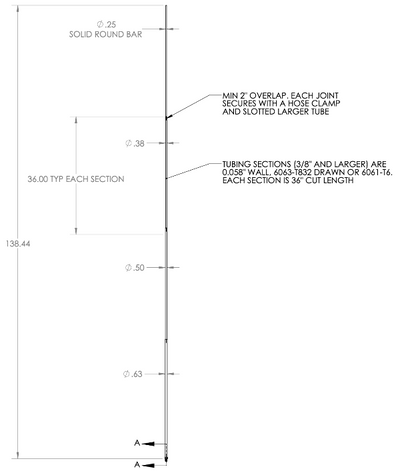
Twenty feet of flagpole a board will approve, with nine feet of whip on top: 160M through 6M from a single feedpoint, no radials, and in NEC modeling its strongest band on 17 meters at about +3.5 dBi. ASCE 7-10 wind-engineered and rated flag up and flag down. Feed it with ladder line, low-loss coax, or buried twisted pair — compare them for your run in the calculator — and give it salt water if you’ve got it.
The Skyline 29 Flagpole → · The 20’ DX Flagpole → · Tilt-Up Base Kit →
Two Ends Of One System. The 9' DX Whip on top adds aperture where every antenna is electrically shortest — it wakes up 40 and 80 meters. The Tilt-Up Base at the bottom brings the antenna to working height, one person — and is how you reach the top to put the whip on. Weekend height, storm prep, and playing around with your antennas: it is how the bands get chased.
The Full System — Signal Lab Curriculum
One antenna is a whole system: radiator, feedpoint, feedline, ground. The Lab covers every piece, and every piece points to the rest:
Aperture & Length: What Your Antenna Actually Grabs · Why Your Antenna Hates 80 Meters
The Feedpoint: Can I Use A 4:1? · Current Vs Voltage Balun
The Feedline: Feedline Loss Calculator · The Feed System
Ground & Radials: No Radials Means Two Things · Ground Is Two Jobs

Designed in Sun Valley, Idaho. Built by hand in the Mountain West.
73 — Jon KL2A · 435-200-4902
Ham Radio is fun again! Pass it on...
Read next · Salt & Weather
Field Notes
The Stainless Swap: Clean, Grease, Snug, and the One Never
Field Notes
The Fall Checkup: Five Minutes That Save Your Winter
Operator Spotlight
Under The Aurora: Working The World From An Icelandic Shore
Everything on Salt & Weather →