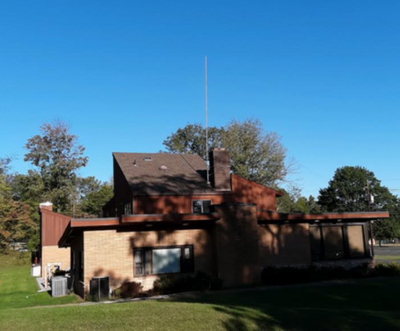
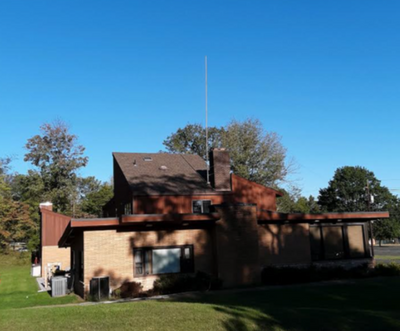
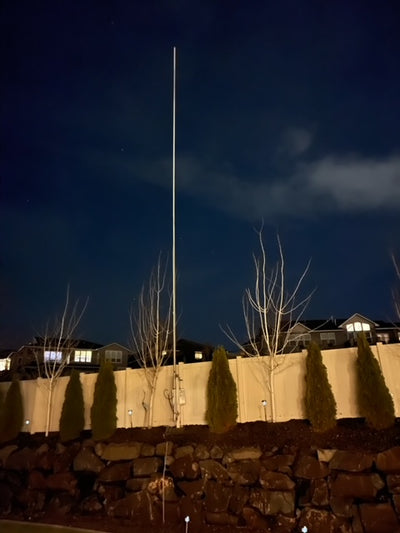
K3QZ: 311 DXCC From a 20' Flagpole. Twice. Moved it to new QTH

Customer Spotlight · K3QZ
311 DXCC entities. Two QTHs. One Greyline.
Ed K3QZ has worked the world from his 20’ DX Flagpole — first from a Pennsylvania HOA, now from a quieter lot in Northeast Ohio. He pulled the antenna out of the ground and brought it with him.
In Ed’s Words
“I transplanted my Greyline 20-foot Flagpole Antenna from the former QTH — which functions as an OCF vertical dipole matched with an LDG RT-100 tuner at the base. Pretty basic, but still keeps the hobby fun.”
— Ed K3QZ, December 2025
Chapter one: Pennsylvania, HOA, 100 watts
When Ed first installed the Greyline 20’ DX Flagpole at his Southwest Pennsylvania QTH in 2021, he was operating from an HOA lot that wasn’t in the clear by any measure. Neighbors on three sides. Trees. The kind of suburban location most operators write off as a compromise.
He was already an experienced DXer — first licensed in 1975, returned to the air in 2004 after a 20-year hiatus, upgraded to Extra Class. CW almost exclusively. He knew what a clean signal sounded like and what a compromised antenna couldn’t do.
The 20’ flagpole worked.

From the Pennsylvania QTH
A few of the contacts Ed sent in.
VK3CWB on 30M CW. Long path to Australia. About 14,500 miles. 100 watts.
TZ4AM on 17M CW. Mali. 589 signal report.
Reverse Beacon Network coverage across all four low bands — 160 through 30M. See the graphs below.
The Reverse Beacon Network proof
Operators new to a small antenna on the low bands often ask the same question: can a 20’ish vertical really get out on 160 and 80? The Reverse Beacon Network answers that one without asking us to take anyone’s word for it.
RBN is a global network of automated CW skimmers that listen continuously and report — with timestamp, frequency, and signal-to-noise ratio — every callsign they decode. No manual logs. No selection bias. If the receiver heard you, it’s in the database.
Here’s what 100 watts into Ed’s 20’ Greyline flagpole looks like across the four low bands. Ignore the sunrise/sunset plots in the corner — these were captured after the fact. Look at the spots and the SNR numbers.


The higher bands — 20, 17, 15, 12, 10 — perform as well or better. As Ed runs them at 5/8 wavelength territory and above, signal strength climbs further. We didn’t reproduce those graphs because the low-band evidence is the harder case to make. If a 20’ flagpole can be heard in Budapest on 160M with 100 watts, the higher bands take care of themselves.
This is what Real DX looks like from an HOA lot.


The number
318 countries confirmed. 311 current DXCC entities plus 7 deleted entities. All on CW. All from a 20’ flagpole running 100 watts.
Most operators don’t hit 311 entities in a lifetime with a tower. Ed did it from a flagpole in an HOA neighborhood.
Chapter two: he moved — and brought the antenna
At the end of 2024, Ed retired from his career as a pediatrician. He and his wife relocated from Southwest Pennsylvania to Northeast Ohio — a more rural QTH. Quieter. More relaxed.
He downsized his station. The Yaesu FT-1000MP, FT-920, and FT-897d — gone. One rig now: the FTDX-3000. No amplifier. 100 watts on the key.
But the Greyline stayed. He pulled the 20’ flagpole out of the Pennsylvania ground, hauled it to Ohio, and put it back up at the new place. Same antenna. Same LDG RT-100 at the base. New horizon.

What This Tells You
Most antennas don’t survive a move.
Wire dipoles get cut. Verticals get scrapped. Towers come down and stay down. When an operator who could afford to start over with anything decides to dig up the antenna and replant it three states away, that’s a vote of confidence no review can match.
Ed’s station, in his own words
From Ed’s QRZ profile, updated December 2025:
“I was first licensed as WN3AXN in 1975 at the age of 13. I continued to operate as WB3AXN until 1984 — mainly CW and DX. After finishing college, I was off the air until 2004.”
“In 2004 I returned to the air still using my old call, WB3AXN. I had kept my license renewed over the 20-year hiatus. After upgrading to Extra Class in 2004, I obtained my present call, K3QZ. I still love CW and DX’ing — that makes up over 99% of my QSOs. Currently I have 318 countries confirmed (311 current entities, 7 deleted entities) — all CW.”
“After retiring at the end of 2024 from a career as a pediatrician, my wife and I moved from Southwest Pennsylvania to Northeast Ohio. It is much more rural than the former QTH, and much quieter and relaxed, too.”
“I have downsized my station to the Yaesu FTDX-3000 only. No amplifier presently (only 100 W). The key is an N3ZN model ZN-5. I transplanted my Greyline 20-foot Flagpole Antenna from the former QTH — which functions as an OCF vertical dipole matched with an LDG RT-100 tuner at the base. Pretty basic, but still keeps the hobby fun.”
A note on the physics
Ed describes the antenna in his own words as “an OCF vertical dipole matched with an LDG RT-100 tuner at the base.” That’s exactly what it is — an off-center fed vertical dipole with the elevated feedpoint that decouples the antenna from near-field ground loss. No radials, no buried wire field, no soil dependency.
When a CW DXer with 311 entities describes your antenna using your own technical framing, that’s the highest form of validation. He understands what he’s running. He chose it. He moved it.
Ed’s Setup
20’ DX Flagpole Antenna + LDG RT-100
The most popular Greyline configuration. Covers 160 through 6 meters from a single feedpoint, no radials required. Ships with HOA Architectural Brief and Property Integrity Letter. Seven-year guarantee. Built to last across moves, decades, and second chapters.
More Operator Stories
Worth a read.
The Signal Report →
Operator stories — first contacts, HOA installs, field deployments.
WC0R — Defense Antenna Executive Picks Greyline →
Career around antennas built for governments. Runs ours.
RF Mastery: The Physics of Balance →
Why the VDA doesn’t need radials.
73 Greyline Performance — 435-200-4902
Ham Radio is fun again! Pass it on…
Read next · HOA
Operator Spotlight
Florida Is Being Heard Again
187 Countries on 35 Watts: Craig W3GF, Seven Years on a 20-Foot Vertical
Operator Spotlight
Two Weeks of Voicemails, Then This: W3GF's 20-Footer and the Whip in a Florida HOA