
Antenna Selection Guide | Greyline VDA 12-28 ft

Antenna Selection Guide · For Every Operator
Which Greyline Antenna Is Right for You?
Five heights. Two form factors. One RF design. Every Greyline VDA (Vertical Dipole Antenna) covers 160 through 6 meters from a single feedpoint with a tuner. The question isn’t which bands you want — it’s which antenna fits your lot, your wind, your HOA, and how much you care about the low bands.
This guide answers that in five steps — for the residential operator, the downsizing tower veteran, and the EOC director alike. Same physics. Same hardware. Same answer process.
Step 1 — Choose Your Form Factor
Both form factors are the same vertical dipole: same aluminum, same machining, same engineering. The choice is environmental and aesthetic.
DX Flagpole — HOA & Residential
Presents as a premium residential flagpole and flies a full-size flag. The pole itself is the antenna, so nothing added identifies it as amateur radio. The right choice for restricted lots, HOA communities, and operators who want a permanent property asset.
Available: 12, 16, 20, 24, 28 ft
DX Vertical — Unrestricted & Field
The bare vertical for unrestricted installations — ground post, rooftop, rapid-deploy EmComm base, POTA, agency installation. Same vertical dipole as the flagpole line, no flag hardware.
Available: 12, 16, 20, 24, 28 ft
Step 2 — Choose Your Height
Every height works every band, 160 through 6. Height is aperture, and it pays most on the low bands: a taller antenna is more efficient on 40, 80, and 160. A shorter antenna carries a higher wind rating and puts its bonus gain higher up the dial. Choose the tallest model your lot, your wind, and your HOA allow.
| Height | 5/8λ Sweet Spot | Wind Rating | Best For |
|---|---|---|---|
| 12 ft | 6M bare · 10M with whip | 155 MPH | Rapid-deploy EmComm, tight lots, high-wind sites, portable base |
| 16 ft | Near 1/2λ on 10M | 115 MPH | Compact lots, front-yard installs, rooftop |
| 20 ft | 5/8λ on 10M | 90 MPH | Standard residential or EOC installation, balanced across the bands |
| 24 ft | 5/8λ on 12M | 70 MPH | Serious DX, larger lots, where the low bands start paying you back |
| 28 ft | 5/8λ on 15M | 55 MPH | Maximum aperture, permanent installations, sheltered sites |
Wind ratings are ASCE 7-10 structural engineering values for the bare antenna — not catalog estimates. DX Flagpole models carry separate flag-up and flag-down ratings; lower the flag when weather threatens. What height should I buy? has every height and rating →
The pattern trade — why height is a choice, not just a race: As a vertical gets taller, low-band efficiency improves. But once it passes about 5/8 wavelength on a given band, the pattern on that band breaks into multiple lobes and more signal goes up instead of out. The 43-foot vertical is the well-known example: excellent on 40 meters, but sending more signal skyward on the high bands. Greyline’s 12- to 28-foot range keeps the popular HF bands on the clean side of that line; the tallest heights, and the whip, trade some high-band pattern — 15, 12, and 10 meters — for more aperture on 40, 80, and 160.

Key: 80M red · 40M blue · 20M green · 15M orange. Notice how the 43’ vertical’s pattern breaks up on 15M — signal goes up, not out. The full 43-foot comparison →
Already know your model? The next question is placement. Where to mount your antenna →
Your Height, in One Page
Leave your email and we’ll send the one-page version of this guide — three questions that pick your height — to keep by the shack.
Step 3 — Why a Vertical Dipole
Every Greyline antenna is an off-center-fed vertical dipole. Return current flows through the lower element, not through buried radials, so there is no radial field to lay and no ground loss in series with the feed. The 2-inch pole lets you place the antenna in the quietest spot on your property — away from the neighbor’s noise, not running toward it.
A traditional quarter-wave vertical feeds at a current maximum at its base, where the ground is part of the circuit — which is why it needs a proper radial field. Getting radials right is real engineering: soil conductivity, radial length and count, and field iteration. Most operators compromise. The vertical dipole removes that dependency by design. The ground is still there, and it still shapes the far-field pattern for every vertical — salt water helps any vertical — but performance depends far less on your soil.
Two numbers worth asking of any vertical: outer diameter and wind rating.
Wind load is a direct function of projected area — height times outer diameter. Greyline publishes both: a 2-inch OD, with every wind rating derived from ASCE 7-10 methodology. Ask for the same two numbers from any antenna you are considering. See the comparisons →
Smart
A vertical dipole with its return current in the lower element, not the soil. No radial field to lay. Place it where your lot is quietest. 160 to 6M from a single feedpoint with a tuner; the 1:1 choke in the box keeps the feedline quiet.
Strong
6061-T6 aluminum. Wall thickness and section sizing engineered per model — we have built with graduated walls and step-down sections, and we choose what each design calls for. Stainless hardware, with 316 stainless for coastal sites. ASCE 7-10 engineered wind ratings. 7-year structural warranty. Built by hand in the Mountain West.
Elegant
Single pole. Single feedline. No radial fields, no guy wires, no visible RF hardware. Flagpole versions present as residential flagpoles. Mount it in a ground sleeve, on a tilt-up base, or on a deck or concrete pad.
Step 4 — Add the 9’ DX Whip (Optional, High Leverage)
The 9-foot DX Whip threads onto any Greyline by hand and adds aperture where every backyard vertical is electrically short. It moves the bonus gain down the dial and adds radiator on 40 and 80. In NEC modeling, the whip configurations peak on 17 meters at about +3.5 to +4 dBi. Add it the day you order, or any time after.
The three Skyline configurations:
Skyline 29 — 20 ft + whip: enough height to wake up 40; bonus gain 30 through 15, about +3.5 dBi on 17.
Skyline 33 — 24 ft + whip: the classic quarter-wave height on 40; equal to a full-radial quarter-wave on 40, about +3.5 dBi on 17.
Skyline 37 — 28 ft + whip: the most aperture we build; at or ahead of a full-radial quarter-wave from 40 through 17, about +4 dBi on 17; multi-lobe from 15 up.
Jon KL2A runs his own station at every one of these heights over time — usually 32 feet with 9 to 11.5 feet of whip on top, and 24 feet when 10 meters opens. Same antenna, more or less aperture, whenever the bands call for it.
The 9’ DX Whip → · The Skyline Series →
Step 5 — What’s Included
Every DX Flagpole Includes
♦ The antenna, 160 to 6M, in 4-foot sections with the couplers already bolted on
♦ Complete feedline kit: ladder line, five snap-on ferrites (the 1:1 choke), ladder-line to PL-259 adapter, spacers
♦ Complete flag kit
♦ Ground sleeve
♦ Assembly documents
♦ 7-year structural warranty
♦ Free shipping to the USA and Canada
Every DX Vertical Includes
♦ The antenna, 160 to 6M, in 4-foot sections with the couplers already bolted on
♦ Complete feedline kit: ladder line, five snap-on ferrites (the 1:1 choke), ladder-line to PL-259 adapter, spacers
♦ Ground sleeve
♦ Assembly documents
♦ 7-year structural warranty
♦ Free shipping to the USA and Canada
Want the tuner too? The antenna plus the LDG RT-100 remote tuner, in one link on the Prices page →
The HOA Architectural Brief, Neighbor FAQ, and every other document a board asks for live in Documents & Forms. For the run from the pole to your tuner — coax, ladder line, or buried twisted pair — compare your options in the Feedline Loss Calculator.
From the Field
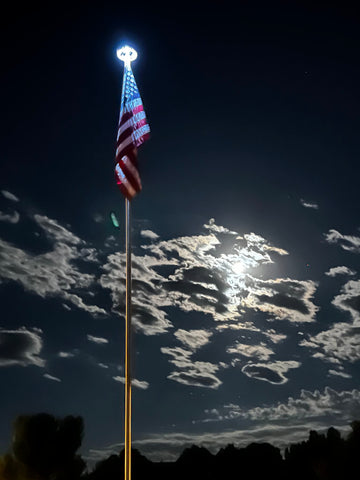
“24’ HOA DX Flagpole under a Wyoming sky — 500+ worldwide contacts logged.” — Jeff, N7TBU
“I work Africa and Europe with just 60W on FT8.” — Bill, WJ8B, 20’ DX Flagpole
Not sure where to put it? Call or email us your address or Google Earth coordinates for a free site review. We’ll suggest the best placement on your property for signal, aesthetics, and structure. No obligation. We’ve been doing this for more than a decade. Contact → · 435-200-4902
The Bottom Line
Every Greyline antenna from 12 to 28 feet radiates on 160 through 6 meters. The low bands reward height. The high bands reward staying near 5/8 wavelength, and each height puts its bonus gain on a different band — shorter heights higher up the dial, taller heights lower down.
The rule is simple: choose the tallest antenna your lot, your wind, and your HOA allow, and be confident in your selection. Whether you need stealth, aperture, or an EmComm base, every model in the lineup is the same vertical dipole — the physics work at every height.
Related Reading
What Height Should I Buy? →
What Is a VDA? The Physics Explained →
Feedline Loss Calculator →
HOA Ham Radio Antenna Guide →
Agency & Gov Solutions →
73, Jon KL2A — 435-200-4902
Ham Radio is fun again! Pass it on…