Field Day Antennas: Bring the Signal Home | Greyline

Field Day Edition · June 27-28
The field is your backyard.
You know the scene. Generators humming before dawn. Coffee going cold next to the paddle. Somebody’s tent antenna that took four operators and a slingshot to raise — working the world on 20 meters anyway. That is the secret Field Day tells every year, and most operators walk right past it.
The Whole Game In One Line
The radio in the tent and the radio on your desk are the same radio. The antenna is the variable. It always was.
What one weekend in a field proves
Field Day is the closest thing our hobby has to a controlled experiment. Strip away the towers and the beams and the decades of accumulated station. Put everyone on emergency power, in a field, with whatever they can raise in a morning. Then watch who works the world.
The clubs that rack up the contacts are not running exotic hardware. They are running real antennas with real aperture, deployed where the RF can breathe — full-size radiators, fed correctly, standing in the clear. A full-size vertical on 100 watts will reach across an ocean when nothing blocks it. That is not a secret. It is physics, and Field Day proves it in public, once a year, on purpose.
The Question Worth Asking On June 29
Why does your station only work like that one weekend a year?
For most operators the answer is not the radio and not the license class. It is the antenna and where it sits. A backyard full of compromise — a short wire under the eaves, a mobile whip on the deck rail, an attic dipole fighting the house wiring — is a field-day handicap you carry all 52 weekends.
No tower, no permit, no slingshot
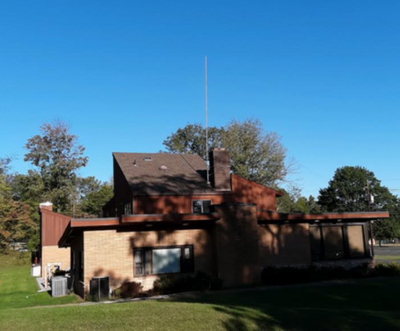
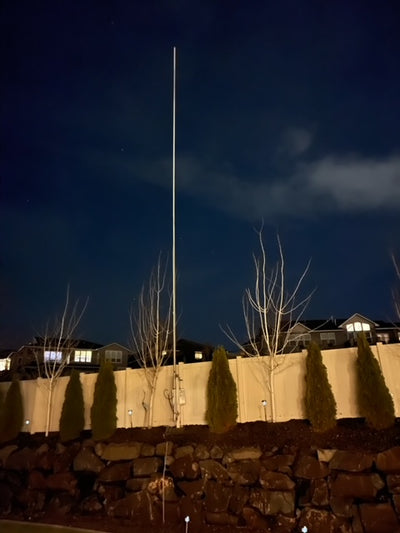
Here is the part that counts after the generators are put away. The full-size vertical performance that wins Field Day does not require a tower, a tuner in the shack fighting a mismatch, or four operators and a slingshot. A vertical dipole needs no radial field and no ground system — the counterpoise is built into the antenna. It stands in your yard looking like a flagpole, because it is one. The HOA waves at it. The DX hears it.
That is the whole trick: real aperture, in the clear, fed right, doing the work that physics says it will do — every weekend, not just the fourth one in June.
After the weekend: read how they really did it
When the dust settles, go read the soapbox reports. For decades, contesters and Field Day operators have posted truthful after-action accounts — what they ran, what worked, what failed at 3 a.m. — on the 3830 reflector archive. It is a free masterclass in real-world antenna performance, written by operators telling the truth about their own stations since before the internet had pictures.
Bring Field Day Home
The signal you borrow for one weekend, built to keep.
If this Field Day you find yourself thinking “I want this at home” — that is the antenna we build. A full-size vertical dipole that hides in plain sight as a flagpole. Designed by an RF engineer, machined in Idaho, 6061-T6 aluminum rated to ASCE 7-10 wind load, and backed for seven years.
Work them all this weekend. Then come home to a station that never packs up.
Two Ends Of One System. The 9' DX Whip on top adds aperture where every antenna is electrically shortest -- it wakes up 40 and 80 meters. The Tilt-Up Base at the bottom brings the antenna to working height, one person, one bolt -- and is how you reach the top to put the whip on. Weekend height, storm prep, and playing around with your antennas: it is how the bands get chased.
The Full System -- Signal Lab Curriculum
One antenna is a whole system: radiator, feedpoint, feedline, ground. The Lab covers every piece, and every piece points to the rest -- no stones unturned:
Aperture & Length: What Your Antenna Actually Grabs · Why Your Antenna Hates 80 Meters
The Feedpoint: Can I Use A 4:1? · Current Vs Voltage Balun
The Feedline: Feedline Loss Calculator · The Feed System
Ground & Radials: No Radials Means Two Things · Ground Is Two Jobs

Designed and Hand-Built in Sun Valley, Idaho
73 — Jon, KL2A · 435-200-4902
Ham Radio is fun again! Pass it on...
Read next · EmComm
Signal Lab
The Quiet Sentinel: Your Neighbor's EmComm Flagpole
Operator Spotlight
AG4FC: MARS Operator's 28' Flagpole on Florida Coast