Townhouse & Condo HF Antennas | Greyline Performance
Signal Lab · Restricted Siting
Real HF From Where You Actually Live
The Townhouse, Condo, and Tight-Lot Operator's Greyline
The most common email we receive from prospective Greyline buyers opens with...
"I don't have a country lot."
"I'm in a townhouse with restricted siting."
"My shack is in the basement and the only run to the antenna is fifteen feet through the window."
"I only have one corner where I can install anything."
"My HOA caps me at twenty feet."
"The ground is frozen six months a year."
The apology is always the same. The operator has decided in advance that their situation disqualifies them from serious HF work — that real DX, multi-band coverage, and the kind of operating they read about in the magazines belongs to hams with acreage, tower farms, and unlimited radial fields.
This article exists to tell you something we've learned across a decade of building antennas for exactly these operators: the constraints you think are disqualifying are often the conditions our architecture was specifically built for. Several of them are actually advantages.
Let's work through the most common ones, because there's real engineering behind why the answer to each one is better than you expect.
Section One
Short Feedline Runs Are A Gift
The first thing every new buyer mentions apologetically is the feedline length. "I only have ten feet from the antenna to my shack." "My run is fifteen feet through the basement window."
If you've ever read antenna discussions on the forums, you've absorbed the assumption that long runs of premium coax are part of a serious HF station. Heliax, LMR-600, hardline — the language of expensive feedline pervades the hobby.
The honest engineering reality: at HF frequencies, ten or fifteen feet of LMR-400 has effectively zero loss across all bands. Even on 10 meters, the loss is a fraction of a dB. A short feedline run isn't a compromise — it's one of the best gifts you can give your signal.
It also solves a problem that operators with longer runs face daily: how to keep your ATU happy. With a short run from antenna to shack, you can put a desktop ATU at the radio, indoors, warm and dry, where you can hear it tune and where the controls live with the rest of your station. The "remote ATU at the antenna" conversation that dominates online discussions exists primarily because operators with hundred-foot runs need to manage feedline loss between a high-SWR antenna and a distant shack. If your run is short, that whole conversation is moot. Both ways have merit.
Your basement-window run to the front yard isn't a problem. It's the install configuration that lets the rest of your station be simple.
Section Two
Tight Lots Favor The 2-Inch Footprint
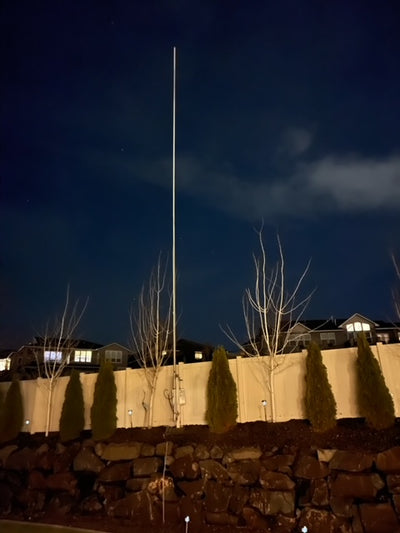
The Greyline VDA is two inches in diameter. The base sleeve install requires a hole approximately twenty-four to thirty-six inches deep, depending on your frost line. The aboveground footprint is the same as a residential flagpole, because that's what it is.
This matters specifically for tight lots. A traditional vertical with a radial field needs sixty feet of clear radius — thirty in each direction and double that for lower bands — to deploy its ground system. A trap vertical needs setback from buildings and conductive structures because the traps interact with their surroundings. A Yagi at twenty feet up needs a tower base, guy wire anchors, and the airspace to rotate without hitting the house or tree limbs.
The VDA needs a circle approximately twenty-four inches across at ground level. That's it. The architecture's elevated off-center feedpoint and balanced floating return current mean the antenna doesn't depend on a buried radial field, doesn't need symmetric ground clearance, and doesn't interact strongly with nearby fence lines, downspouts, or HVAC equipment.
For a townhouse front yard, a condo deck, a corner lot with utility easements eating up the back, or a property where you're squeezed between neighbors, the small footprint isn't just convenient. It's what makes the install possible at all.
Section Three
Indoor Shack ATU Is Preferred, Not A Compromise
This one comes up so often it deserves a section of its own.
Operators read about remote ATUs mounted at the antenna and assume that's the "right" way or ONLY way to install a serious HF station. Combined with the "long run of premium coax" assumption above, this creates the picture of a complex, expensive, weather-exposed installation that intimidates new buyers.
The reality for most Greyline buyers: an external desktop ATU at the shack is the right answer.
Here's why. The Greyline's off-center-fed vertical dipole feedpoint presents widely varying impedance across the ham bands. Sometimes 50 ohms, sometimes much higher, sometimes complex with significant reactance. An external ATU absorbs that variation and presents a flat fifty-ohm match to the radio across all bands the antenna covers (160 through 6 meters in our case).
Where that ATU lives is a separate question. Two paths:
Remote ATU at the antenna base. The easy math go-to when the feedline run between antenna and shack is long enough that the loss between an unmatched antenna and a distant ATU starts to cost real dB. Generally seventy-five feet or longer. Add budget to the feedline quality and size or install the remote ATU is the typical trade-off.
Desktop ATU at the radio. Right answer for shorter runs. The ATU lives indoors, you can hear it tune, you can override it for difficult matches, and it stays warm and dry through whatever winter or saltwater corrosion your local climate throws at the install. Let's not forget the built-in mitigation of random and costly possibilities our neighbors and guests might present.
For townhouse operators with short basement runs — exactly the buyer profile this article is written for — the desktop ATU is the simpler, more reliable, and lower-cost path. LDG AT-200ProII or AT-600ProII for the budget-conscious. ACOM and Tuner Genius (4O3A.com) for bullet proof quality, and Palstar HF-AUTO, for the operator who wants Made-in-USA quality and twenty-year longevity.
What you don't want, in either case: your radio's internal tuner alone. Internal tuners are designed to match SWR up to about 3:1, which covers some bands on the VDA but not all. You'll be limited to a couple of bands and the antenna won't deliver what it should. An external ATU is non-negotiable. Where it lives is the choice.
Section Four
No-Radial Architecture Eliminates The Restricted Siting Problem
If you've been around HF antennas long, you've internalized the assumption that a vertical needs radials. Sixteen of them minimum. Sixty of them ideally. 120 radials for Broadcast Engineering Standards. Buried six inches deep across the lawn, or elevated like a maze of clotheslines. Connected to a central tie point with low-resistance straps. Replaced every five to ten years as oxidation kills the system. Not only complex in nature, but likely noisy too.
The radial field assumption is the single biggest reason townhouse and tight-lot operators self-disqualify from vertical antennas. It's also wrong for the Greyline VDA.
The Greyline architecture is a vertical dipole — the radiating element and the return current path are both built into the antenna itself, above ground. The return current doesn't flow through the soil. It flows through the antenna's own lower element. There is no radial system to bury, no ground field to maintain, no oxidation problem to revisit in a decade.
For a restricted-siting buyer this changes everything. Frozen ground? Doesn't matter — the antenna doesn't depend on soil conductivity for performance. Paved driveway? Same. Six feet of snow? Same. Tight lot with no clear radius for radials? Same. Underground utilities you don't want to dig around? Same.
The architecture wasn't built specifically for townhouse operators. It was built around the physics of an elevated off-center feedpoint that doesn't require a buried counterpoise. But the practical effect is that the townhouse, condo, and tight-lot operator gets to have the kind of HF performance that traditional verticals require an acre of cleared lawn to deliver.
Section Five
Underground Utilities Are A Dig-Day Concern, Not A Performance Concern
Several buyers have asked us whether running an HF antenna near their underground electrical service, gas line, or telephone trunk creates problems with the antenna's performance.
The honest engineering answer: no. Underground utilities are buried, shielded, and electrically isolated. The antenna's near field at HF doesn't meaningfully interact with them. Once the install is complete, the antenna operates the same way regardless of what runs underground nearby.
The real concern is during the dig. The base sleeve install requires a 24-36 inch hole. Hitting a buried utility line is dangerous, expensive, and easily preventable.
Before any install, call your local Call Before You Dig service. In the United States, the universal number is 811. In Canada, each province has its own service — Ontario One Call (1-800-400-2255), Alberta One-Call (1-800-242-3447), BC One Call (1-800-474-6886), and equivalents elsewhere. The call is free, the marking is free, and the time required is typically a few business days from request to marked utilities visible on your property.
Once marked, place your base sleeve at least thirty-six inches from any utility line (three feet is the safe margin). Dig with hand tools rather than mechanized equipment within five feet of any marked line. Once installed, forget about the utilities — they don't interact with the antenna again.
Section Six
Winter, Snow, And Frozen Ground Are The Case This Architecture Was Built For
The last apology from northern-tier buyers is usually about climate. Frozen ground for half the year. Snow burial of equipment. Ice loading on the antenna itself. Wind exposure across lakes or open prairie.
These are real concerns and we take them seriously. But the architecture handles them better than the buyer often expects.
Frozen ground. The VDA doesn't depend on soil conductivity. The antenna performs the same in January as it does in July. Operators on Lake Huron, in Alberta winters, and in Alaska report the same on-air results year-round.
Snow burial of base equipment. This is real, particularly for operators considering a remote ATU at the antenna. The cleanest solution: don't put the ATU at the antenna. Keep it indoors at the shack. For short feedline runs the performance penalty is essentially zero. For longer runs that genuinely need a remote ATU, the unit can be mounted on a non-metallic post (fiberglass, PVC, treated wood) four to five feet above grade (your expected snowline) in a weatherproof enclosure rated for your climate.
Ice loading. The 2-inch OD aluminum construction handles ice well within the ASCE 7-10 wind ratings published for each height. The standing rule for any operator in heavy-weather territory: drop the flag before forecast severe weather. Five-minutes, dramatic survival improvement.
Wind exposure. Height-specific ratings, flag-down and flag-up columns published transparently. Coastal Alaska, Plains states, Great Lakes shorelines, and Atlantic Canada are all installable with appropriate sizing and storm protocol.
The Hidden Geographic Advantage
One thing the townhouse and lakeside buyer often doesn't realize: their location may actually be advantageous.
Operators on large bodies of water — the Great Lakes, Atlantic and Pacific coasts, Gulf coast, large inland reservoirs — work with a ground-conductivity asset that inland operators don't have. The water acts as an electrically reflective surface for low-angle radiation toward the body of water. This is one of the reasons coastal operators historically dominate DX contests: the saltwater (or large freshwater) ground extends their effective ground plane far beyond what their actual installation provides.
You may not have an acre of lawn. But if you're near Lake Erie, Georgian Bay, Puget Sound, the Chesapeake, or any large open water — you have an antenna feature that the operator in inland Nebraska can't buy at any price.
The Bottom Line
What This Adds Up To
The townhouse, condo, and tight-lot operator who has been talked out of serious HF by the conventional wisdom of vertical antennas has been working from outdated assumptions.
- The short feedline run isn't a limitation. It's a structural advantage that lets your ATU live indoors.
- The 2-inch antenna footprint isn't a compromise. It's what makes the install possible on properties that wouldn't tolerate a traditional vertical.
- The lack of radial system isn't missing infrastructure. It's the physics that makes the architecture work on restricted siting.
- Underground utility proximity isn't a problem. It's a dig-day procedure you handle with one phone call.
- The frozen ground, the snow, the lake at your back — these aren't obstacles. Several are advantages.
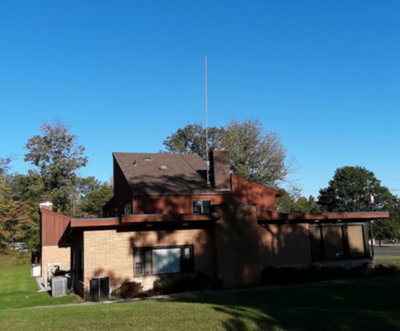
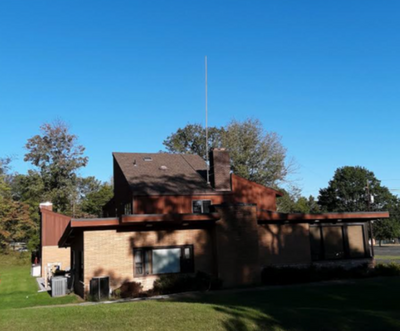
We've shipped Greyline antennas to operators in Ontario townhouses, Alaska coastal homes, Phoenix HOA developments, Colorado mountain residences, Florida hurricane country, Cleveland suburbs, Sun Valley canyons, and Great Lakes shorelines. The architecture works in all of them because the physics is the same. The constraints that seem disqualifying when you're shopping for a traditional vertical become non-issues when the architecture doesn't depend on them.
If you've been telling yourself you can't have a real HF antenna because of where you live — it may be worth a second look. The buyers in this category are some of our happiest customers. They came in expecting to be told no. They got told yes, here's how, and they've been on the air ever since.
Real Questions, Honest Answers
Start With A Conversation
If you're a townhouse, condo, basement-shack, or tight-lot operator considering a Greyline, the most useful first move is a phone call. Not an order, not a commitment — just a conversation about your specific situation. Frost line in your area, building setbacks, your radio and current station gear, what bands you want to work, what your shack looks like.
The conversation usually takes fifteen minutes. By the end of it, you'll know whether the Greyline is the right answer for your situation, what configuration fits your install, what the install timeline looks like, and what the conversation with your HOA (if applicable) needs to address.
Talk To The Operator
The Architecture Works In Restricted Spaces
The question is whether it's the right answer for yours. Call 435-200-4902 , Sun Valley mountain time. Or email and we'll set up a time. Five minutes, operator to operator.
Jon KL2A is the founder of Greyline Performance Antennas, builder of HF vertical dipole arrays in Sun Valley, Idaho. Greyline has shipped antennas to operators across North America for over a decade.
Ham radio is fun again. Pass it on.
Read next · Getting Started
Greyline Life
How Greyline Works: The Clubhouse, The Bookshelf, The Tools, and You
Field Notes
Why Your Greyline Ships In Two Boxes
Operator Spotlight
W7TLG: Black Beauty on the Bench - An Engineer's Build
Everything on Getting Started →