Low Band & WARC Primer: 160-12M DX as Cycle 25 Peaks

Propagation · Antenna Tuning · Cycle 25
Low Band & WARC Primer: Your Guide to 160, 80, 60, 40, 30, 17, & 12 Meter DX as Cycle 25 Rolls Over
Solar Cycle 25 has peaked. The high bands are no longer the sure thing they were 18 months ago. But the low bands and the WARC bands are wide awake — and the operator who’s ready for them is the operator who fills the logbook this season.
This is a working primer. Pre-flight inspection. Tuning procedure. Band-by-band guidance for 160 through 12 meters. And one Pacific Ocean story that proves the physics doesn’t care about your ZIP code.
The Pre-Flight Check
Before you tune, inspect. Five minutes here saves an evening of chasing ghosts.
Physical inspection. Walk the antenna system. Connections tight. Coax free of damage. Winter brings ice and wind, so reinforcing now matters. Confirm your flag-lowering procedure for storm readiness.
The tuner. Is your automatic antenna tuner (ATU) ready on all bands? If outside, it sits at least 6 inches off the ground on a non-conductive support — PVC, wood block, or equivalent. Indoor ATU: bypass the radio’s internal tuner during initial tests. Follow ARRL grounding guidance.
The RF choke. Common-mode current is what makes your coax act like the antenna. The choke (or balun) sits on the radio side of the tuner. For a remote ATU at the antenna, that means it’s at the feedpoint. For a shack-side ATU, it’s at the back of the tuner on the coax side. Some chokes age with high-power use — verify yours is doing its job.
The center conductor. The upper radiating element of the vertical connects to the center conductor of your coax feedline. Simple mistake to make. Worth a double-take.
Disconnect ground for tuning tests. For initial diagnostics, disconnect the tuner from station ground. This isolates the antenna/tuner system and simplifies troubleshooting. Reconnect and verify once you’ve confirmed everything is working.
The Tuning Procedure
Most “it won’t tune” problems are solved here. The ATU needs a steady carrier. SSB key-up won’t feed it.
- Disable the radio’s internal tuner. Set the transceiver’s internal ATU to BYPASS or OFF. The external tuner does the work.
- Select a constant-carrier mode. AM or a digital key-down mode. The tuner needs continuous signal.
- Lower the power. 15–25 watts for the tuning cycle. No need for full power.
- Engage tune. Pick the frequency, hold PTT, watch the SWR meter. The tuner clicks and clacks, finds the match, settles. Release PTT.
- Operate. Switch to your preferred mode, run your normal power, go to work.
Train the tuner’s memory.
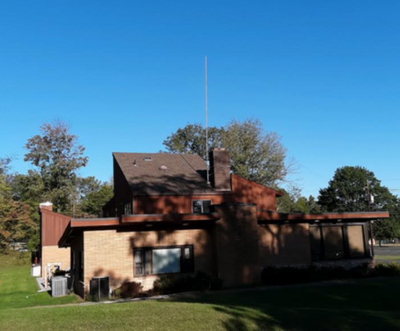
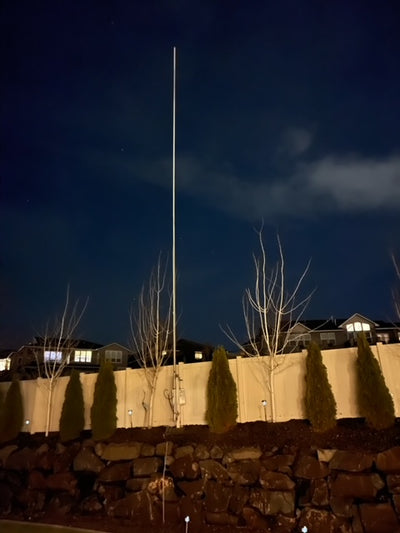
Modern ATUs hold thousands of memory slots. Take a few minutes to run a tuning cycle on every band from 10M down to 160M, including all WARC bands. This trains the tuner’s memory. Once stored, a Greyline 24-foot DX Flagpole with an LDG remote tuner switches from an 80M setting to a 15M setting in under half a second.
Antenna Physics Doesn’t Care About Your ZIP Code

Photo: Dxpedition team of N5J / K8R / E51D — central Pacific Ocean
Featured: The Jarvis Island Lesson
The N5J DXpedition to Jarvis Island worked Europe on 160 meters. From the middle of the Pacific Ocean. With a vertical antenna similar to the Greyline and a remote tuner at the base.
The platform was a luxury vessel that crossed thousands of miles of open water to put the operators and even more antennas, on Jarvis. The antenna and tuner topology was structurally identical to what sits in thousands of Greyline operators’ backyards: a vertical, an ATU, and a coax run back to the rig.
The difference was salt water.
Salt water is an essentially perfect RF ground plane — conductivity orders of magnitude higher than soil. A vertical antenna at the edge of an ocean borrows that conductivity and radiates with low-angle efficiency that a tower-and-Yagi land station can’t match. The N5J team didn’t beat the laws of physics. They picked a location where the physics did most of the work for them.
For your suburban HOA lot, the same physics applies in smaller doses. Your ground isn’t salt water. But the antenna topology that worked Europe on 160M from Jarvis — vertical, remote ATU, low feedline loss — is the same topology that puts your 100 watts in distant logs from a residential property. Antenna physics doesn’t care about your ZIP code. It only cares whether the antenna is honest about what it is.
The Low Bands — 160, 80, 60, 40 Meters
Most Greyline owners find their 20-foot, 24-foot, and 28-foot verticals tune to 160 meters with ease, enabling routine DX contacts of a thousand miles or more. The lower you go in frequency, the more demanding it gets on the matching network.
160 meters opens after sunset and stays open through the night. North America to VK/ZL and the South Pacific is currently normal. This band rewards patience — the operator who’s on the frequency when the band opens, not the operator who shows up looking for a contact at 2 AM, fills the log.
80 meters opens after sunset and runs deep into the night. The 5/8λ sweet spot on 80M wants tall — this is where a 28-foot DXF with a 9-foot whip extension (total 37 feet) starts to shine. Shorter verticals work the band; longer verticals work it even louder.
60 meters (5 MHz, US channels) sits between 80 and 40 in propagation behavior. The Greyline verticals tune it cleanly through the ATU. Underused by most operators — meaning the band is often clear of QRM when the DX is workable. Worth a spin, your tuner will tune it.
40 meters opens about an hour or even two before sunset and remains the most consistently productive DX band after dark. Long-path propagation near sunrise and sunset is normal. Teh array of Greyline antennas work 40M like a champ. Give it a whirl with your radio and tuner set up. Operators chasing serious 40M performance reach for the 28-foot. The 9' whip addition was made to maximize the lower bands on your lot.
Tuner runs out of range on 80M or 160M? Many small ATUs hit their impedance ceiling on the lowest bands. The Greyline 4-foot Extension Kit and 9-foot DX Whip add electrical length that brings the impedance into range for the smaller tuners and adds aperture — up to 3.5 dB on some bands. The 9-foot whip turns a 24-foot DXF into a 33-foot system that hits 1/4λ on 40M and 5/8λ on 17M. For low-band work, longer is better, and the math is straightforward.
The WARC Bands — 30, 17, 12 Meters
The WARC bands — 30, 17, and 12 meters — were allocated to amateur use at the 1979 World Administrative Radio Conference. They sit between the traditional contest bands, which means they’re typically quieter and reward the casual DX hunter who isn’t fighting through a deep pileup.
30 meters opens well before sunset and stays open through the night. Long-path within a few hours of sunset and sunrise is normal. A CW and digital-only band — no SSB — which keeps the QRM down. Greyline verticals tune it cleanly. Underused.
17 meters is currently a workhorse. Excellent propagation across mid and low latitudes throughout the day and into the evenings. Don't rule out the darkness paths to the east. For a 24-foot DXF with the 9-foot whip extension, 17M sits exactly at the 5/8λ sweet spot — the band where the antenna runs its peak gain. This is where our 33-foot Greyline station owner can outperform tower-and-Yagi installation on a watts-per-watt basis. Low angles have rewards.
12 meters is now showing seasonal degradation. As the cycle rolls over, lower MUFs are beginning to compress 12M long-distance F2 propagation at mid and high latitudes in the northern hemisphere. The band still opens for shorter paths and across auroral zones — but the days of routine deep DX on 12M from the northern US are winding down for this cycle. Work it now while it’s still there.
A Word on SWR: Don’t Chase Perfection
A perfect 1:1 SWR is the goal. Don’t obsess over it. SWR of 1.5:1 or even 2:1 is acceptable for operating and will not harm modern transceivers.
Rain, snow, or a nearby obstruction can shift SWR slightly. If you notice a change, run a quick re-tune (AM mode, 20W, PTT). For very minor shifts, the radio’s internal ATU handles it — this is exactly what those internal tuners are for.
Chasing the last decimal point matters less than getting on the air and making contacts. Every watt that propagates is one we love — but a 2:1 SWR is propagating, not heating up the feedline as much as some might think. For the physics, we read Robert Zavrel W7SX’s Antenna Physics: An Introduction (ARRL, 2020). Bob’s on our Authority Bookshelf for a reason. See the full bookshelf →
See Your Signal Span the Globe
Curious where your signal is being heard right now? You don’t need to call a friend. The internet and a few hundred global HF listening stations do it for you.
Reverse Beacon Network (RBN). CW ops only. Pick a band, find a clear frequency, call CQ a few times (CQ CQ callsign callsign), then enter your callsign on the RBN website. You’ll see a map and list of stations around the world that heard you — with signal-to-noise ratio (SNR) reports in dB.
PSKReporter. Digital modes — FT8, PSK31, others. Same idea as RBN: real-time map showing where your digital signal is being decoded.
WebSDR. Want to hear your own audio from halfway around the world? Find a station on RBN or PSKReporter that’s hearing you well. Go to a WebSDR receiver in that area, tune to your frequency, call CQ, and listen to yourself from thousands of miles away.
When to listen.
Get Your Station Dialed In
For the residential operator, the EmComm volunteer, or the operator coming off a tower and looking to simplify — this season rewards the station that’s ready. Cycle 25 has peaked. The low bands and WARC bands are wide open. The antenna physics doesn’t care about your ZIP code. It only cares that your station is honest about what it is and tuned for the work ahead.
More from The Signal Lab
Antenna Selection Guide — Which Greyline Is Right for You? →
Free Greyline Tool: Feedline Loss Calculator →
Feedline Physics — Why Coax Choice Matters →
What Is a VDA? The Physics Explained →
K3QZ: 311 DXCC From a 20-Foot Flagpole. Twice. →
N0CPO: 100 DXCC in 9 Months. 100W. 20ft Flagpole. →
73 Greyline Performance — 435-200-4902
Ham Radio is fun again! Pass it on…
Read next · Low Bands
Signal Lab
What Is the Greyline? The Twilight Band That Carries DX
Signal Lab
Why Your Antenna Hates 80 Meters
Operator Spotlight
K3WA Works 160M Contests from HOA on 24' Flagpole | Greyline