Half My Pileup Gone: A Thousand Pounds of Aluminum for the Butte

The Signal Report · From The Road
Half My Pileup Gone: A Thousand Pounds of Aluminum for the Butte
There is a lot of Montana in Montana. You notice it when a thousand pounds of aluminum is riding your roof rack, because aluminum on a rack wants to fly, and there is nothing between you and the horizon to argue with it. Elements. Booms. A whole set of antennas still in pieces, headed for a ranch where they finally get their first real negative horizon.
Coffee in hand. Mecca of the West somewhere out ahead. This is the story of why.
The Kid Who Took Half My Pileup
I was in high school, operating from my parents' house in Alaska, doing what you did from Alaska in those days: running Europeans over the Pole. That path is a privilege and a fight at the same time. You sit on the edge of the auroral zone and the band gives you what it gives you, and when it opens the whole continent lines up on your frequency.
One afternoon the pileup was deep and steady and then, between one QSO and the next, it was half gone. Not faded. Gone. I thought the band had died. I spun the dial and found the reason a few kilohertz away: a new guy, on the same band, running the same Europeans over the same Pole, on CW. Taking the other half of my pileup.
That was WL7KY. The early version of the man the contest world now knows as KL9A.
The local contest crew watched him get better, which did not take long, and did what good contest crews do: they invited him to a multi-multi weekend at Dan Robbins' KL7Y, the big contest station we all grew up at. I picked Chris up at his high school in my little Acura. Bob Marley on the stereo, radio talk the whole drive, headed for a weekend he was going to remember for the rest of his life. I am assuming that last part. He can correct me.
Dan is a Silent Key now. A motorcycle took him in the fall of 2002. He was first licensed in 1963, and as a boy he once carried a 15-meter beam three miles on foot to get it home. He built the station a generation of Alaska operators grew up at — where we learned what a real pileup sounds like — and he opened it to two kids in an Acura. That is the kind of man the hobby runs on.
Why There Is a Thousand Pounds on the Truck
Some years ago these antennas came available from an operator on the coast of Washington who was downsizing and wanted the whole lot to go to one place. An 80-meter Yagi. A 4-element 40. Big monobanders for 20, 15 and 10 on long booms — at least that is what I was told, and the rack agrees. I bought them and held them, hoping they would go up, and had them delivered to a piece of land in northeast Washington, up against the Idaho line, where a partner and I were building a radio station. I was lucky enough to be part of it for five good years.
We built real antennas there. A thousand-foot run of open-wire line up the side of a mountain, with tuners along the way for fine adjustment. Multiband antennas on a rotator on a tower. A full-size bobtail curtain on 80. A three-element vertical array fired broadside to Europe over a cliff, good for about 5 dB of gain, and it worked the long path too. And it was quiet — not us, the place. You could hear a pin drop in the Pacific and another one in the Atlantic. An amazing QTH, and I learned more about the basics there than anywhere. Having an RF physics professor alongside a wrench, a ladder and a meter is like going back to school, and everything I learned on that mountain came with me to Greyline.
We built receive antennas too, though I did not think we needed them at a place that quiet. The professor believed in a razor-sharp quad loop for listening — the same idea as the small loops people run on a desktop, scaled up. So we built one: a diamond with 18-foot legs on each side. Then we added a second element and phased the pair toward Europe, and it put a knife-edge receive pattern on the station — something like 35 dB front-to-back. It taught me that hearing is a separate discipline from transmitting, and it gave me an idea for listening that I have been carrying around ever since.
But those big Yagis never went up. That happens more than anyone admits. The station got built around other things, the seasons went by, and the big iron sat in a pile waiting for a weekend that never came. Then the land sold, and my own radio life had already drifted east — most of my adventures these days are on the East Coast and in the Caribbean. And maybe, now, a few at the Butte.

Loading day at the property on the Washington–Idaho line. Five years on the ground, one morning on the rack.
So they are going to Chris. Not sold. Gifted, to the one man I know who will absolutely put them in the air, because I have watched him do it once already, from nothing.
This is what happens in this hobby when a set of high-performance antennas comes loose. Somebody downsizes. Somebody else takes a turn — uses them, or holds them, or just keeps them out of the scrap yard — and then passes them on. Hank Williams is gone and his guitars still make the rounds. Neil Young sang something close to it once: it is only our turn for a little while. I am just doing my part. It is not about me, and it was never about the aluminum. It is about who gets to hear Europe next.
The Butte
Chris has a background in mapping, and he found his ground the way a mapper would: after a great deal of looking. Raw land on the eastern side of Montana, with a negative horizon in every direction. We call it the Butte.

Sunset on the Butte: the 80 and 40 meter 4-squares. Verticals, on the right ground. Every Greyline owner will recognize the idea.
He is far enough east that he is not sitting under the auroral donut, and Europe is not blocked to him the way it is to stations farther west and north on a bad night. I know exactly what that is worth, because our station on the Washington–Idaho line sat about four hundred miles west of the Butte, and I have listened to him run Europeans while I was pointed at the aurora, bouncing off it, not quite getting in. Other nights I felt pretty loud myself. Four hundred miles is enough to see the difference easily. That is the deal you make when you live near the edge of the oval.
And here is the part I want every operator to hear. I watched that station go from a vertical antenna and 50 watts — one vertical, on the air at the same time as some of the largest stations near him, and holding his own — to Yagis on every band, with more towers going up. He did not start with towers. He started with a piece of aluminum in the ground on a good piece of land and an operator who knew what to do with it.
And he is not building it for himself. That is the thing about the Butte. Chris is building the dream and sharing it — with the old crew who remember KL7Y, and with newcomers who have never stood under a real antenna and are about to. A station like that is a shared passion or it is nothing. Felipe, NP4Z, who has spent a lifetime in pileups, put it the way I would have if I were quicker: "Life could be sweeter, I guess, but nothing comes to mind."
The Teach: What a Negative Horizon Actually Is
Nothing in the way. That is the whole definition. The ground falls away from the antenna in every direction, the nearest mountains are very far off and very low, and there is no obstruction at one degree above the horizontal. One degree. That is the takeoff angle where long-haul DX lives, and most stations never get to use it because a hill, a tree line, or a neighbor's roof is sitting in it.
Two things follow, and they matter to a flagpole owner as much as to a man with towers. First, the physics does not care what the antenna looks like. John Kraus, W8JK, wrote the book on it: aperture is measured in wavelengths, not feet, and the low-angle lobe of any vertical or any Yagi is shaped by the ground in front of it out to many wavelengths. A negative horizon gives that lobe somewhere to go. Second, terrain is the one thing you cannot buy in a box. Dean Straw, N6BV, spent years in the ARRL Antenna Book on exactly this — how the slope of the ground ahead of you shapes the takeoff angle — and the conclusion holds for every station: a modest antenna on the right ground beats a big one on the wrong ground, over and over.
Chris found his ground. Then he earned the towers.

After sunset: a stack of Yagis on one tower. More going up.
And here is what people who have never built a big station get wrong about the towers: the antenna does not automatically go on top. Signals from a given part of the world arrive at a given range of angles, and that is not a mystery anymore — the ARRL Antenna Book publishes the elevation-angle statistics path by path, and Straw's terrain modeling puts them against the actual ground under the tower. A Yagi's height above ground is what aims its main lobe up or down. So a 40-meter beam aimed at Europe from Montana may want to sit at 75 feet, not at the top, because that is where its lobe meets the angle Europe arrives at. And with a horizon like the Butte's, the ground is already doing part of the job a taller tower does elsewhere — he may not need to go as high as a flatland station would. Chris knows this better than I do. I cannot tell you how high these antennas will go. I can tell you they will each go exactly where the angles say, and not a foot higher for the sake of it.
The Other Side of the Truck
A lot of the operators who buy a Greyline understand a superstation very well. Many of them have operated at one. Some of them built one, from a single vertical to the full ranch, exactly the way Chris did. They know what 1,000 pounds of Yagi on a rack means, and some of them are quietly wishing they were in the passenger seat right now.
And then a thing happens that happens to the greatest of us. Folks get older. The climbing stops being wise, and then it stops being possible. The towers come down, the land sells, and one day you find yourself at the golf course with your wife and a dog named Pucci, in a neighborhood with an architectural committee.
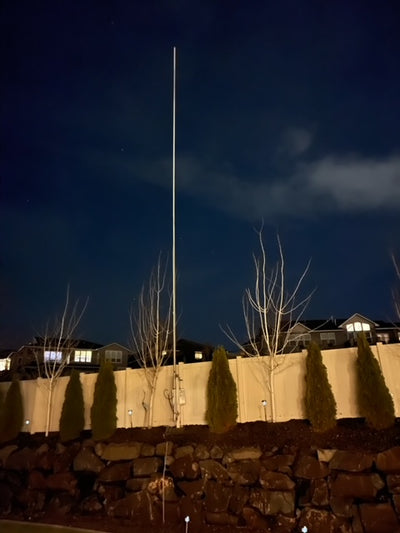
The men who put up a flagpole antenna from that address are not finished. They still get in the action. They still work DX. They still have a lot of fun from their little slice of heaven in the Florida Keys, or wherever they have earned the right to call home. Same physics. Same operator. Different chapter. The flagpole is not the antenna you settle for. It is the one you choose when you have already had the towers and you know exactly what you want to keep.
Where The Big Ones Live
Want to see what a station like the Butte does in a contest weekend? The 3830 reflector archive is where operators post their scores and their notes the morning after, and it has been doing that for decades. Look up KL9A. Then look up the vertical years, if you can find them. And CQ-Contest is where the arguments about what actually wins have been going on for thirty years. Humbling and worth it.

From the driver's seat. A few tubes leading the way.
Young antennas in training, riding to a ranch where the big towers will show them real DX someday. Chris, if I have any of this wrong, you know where to find me. Probably a few kilohertz up, working the other half of your pileup.
Postscript — Sunday Morning, KM7W Radio Ranch, The Butte

Sunday morning. Tin can, coffee, radio on.
Spent the night at KL9A's KM7W Radio Ranch on the Butte. Woke with the sun. Wide open, big skies, Montana.
Stumbled out to kick on the generator. Water boiled. Radio on. Eastern Montana mornings cut sharp this time of year, and the thick ski vest earned its keep. Bands quiet. CQ on repeat.
Westbound soon, to where the coffee comes in paper cups with your name on it. For now, tin cans and a boil. That will do just fine.
Hand key on 14028, 21028 and 28028 for an hour or so more, steak and eggs on the barbecue. If you stop in for an RST, you will find me.
73 de KL2A/7
Ham Radio is fun again! Pass it on...
73 de KL2A
Somewhere in Montana, coffee in hand
Greyline Performance — Sun Valley, Idaho
Read next · Height & Gain
Signal Lab
Nine Feet You Have Not Used Yet: What the Whip Actually Buys
Signal Lab
20 Meter Vertical Antenna: Which Height Works Best?
Signal Lab
The Other Half of Your Antenna Has to Go Somewhere