KE6TT Review: 20' to 24' Greyline, SWR 1.0-1.3 on Low Bands
The Greyline Blog › KE6TT/4: 20 to 24 Feet in Central Florida
Operator Spotlight · KE6TT/4
From 20 Feet to 24: An Upgrade Path, and the SWR Numbers Behind It
See the 4’ extension that took him to 24’ →
The Upgrade Path
Start at 20, grow to 24 — same antenna, more low band
KE6TT’s station in central Florida is a useful one to study, because it shows the path rather than just the destination. He installed a 20-foot Greyline in his HOA backyard at the end of January, then added the 4-foot extension kit to bring it to 24 feet. That extra aperture is not cosmetic — on a vertical, length buys low-band efficiency, and his numbers show exactly where it pays off.
He runs an SGC-230 tuner at the base of the antenna, feeds FT4, FT8, and SSB, and reports no HOA complaints since the day it went up. All contacts at 70 to 100 watts.
The Data
What the SWR actually tells you
40 – 160M
SWR 1.0 to 1.3 through the base ATU. The low bands are dialed in.
Most bands
SWR at or under 1.5; 12M the one outlier, just under 2.0.
Here is the honest read of those figures, because a low SWR is widely misunderstood. SWR tells you how well the system is matched — how much power the transmitter can deliver into the feedline without reflection. It does not, by itself, tell you how well the antenna radiates. The two get conflated constantly. What makes KE6TT’s report credible is that the match is excellent and he is working the DX to back it: Europe and Africa on 100 watts, plus steady FT4 and FT8 with good reports.
His one caveat is worth repeating because it is true of every vertical: he works mostly 10 through 28 MHz and does little on 40 through 160, simply because he is not a night owl. The antenna’s 1.0 to 1.3 match on those bands says the capability is there waiting — the limiting factor is the operator’s schedule, not the aluminum. Why length and the vertical-dipole design drive low-band performance →
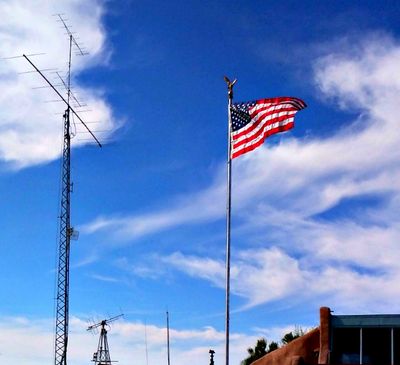
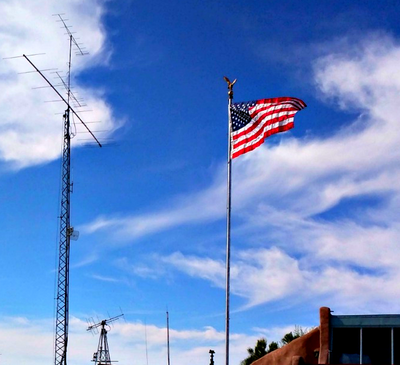
One honest note. KE6TT’s flag shredded after three months. It was an imported flag, not up to the standard a US-made flag holds — the federal guideline is roughly 90 days of daylight flying for nylon or cotton, and a flag flown around the clock can last a quarter as long. We had already reached out and sent him a replacement. The antenna is the product; the flag is a courtesy, and we hold both to the same standard.
Read From the Source
Where SWR, matching, and radiation get untangled
The match-versus-radiation distinction is one of the most useful things a new operator can internalize. The authorities on it:
W8JI on SWR, matching, and feedline loss — rigorous, testable, and unsentimental about common myths.
Greyline’s own feedline physics page — the same ideas, applied to a vertical dipole.
And for the night-owl bands KE6TT has not fully worked yet, the ARRL Propagation Forecast Bulletin tells you when 40 through 160 are open. Carried for years by Tad Cook, K7RA, a Silent Key since April 2025; the ARRL continues it in his memory. Pro Tip: 40–160M are enhanced at sunset, and especially just before sunrise. Enjoy!
Your Station
Buy the 20, grow into the 24
KE6TT’s path is one anyone can take: start with the 20-foot flagpole, add the 4-foot extension when you want more low band. Same antenna, more aperture, better numbers where length matters most. Pro Tip: the 9’ DX Whip threads into the top of any Greyline for more still.
Go Deeper
Feedline physics: SWR, matching, and loss →
Best HF Vertical, No Radials — the physics →
The Bookshelf We Read From →
Which Greyline antenna is right for you? →
73, Jon KL2A · 435-200-4902
Ham Radio is fun again! Pass it on…
Read next · Low Bands
Signal Lab
What Is the Greyline? The Twilight Band That Carries DX
Signal Lab
Why Your Antenna Hates 80 Meters
Operator Spotlight
K3WA Works 160M Contests from HOA on 24' Flagpole | Greyline