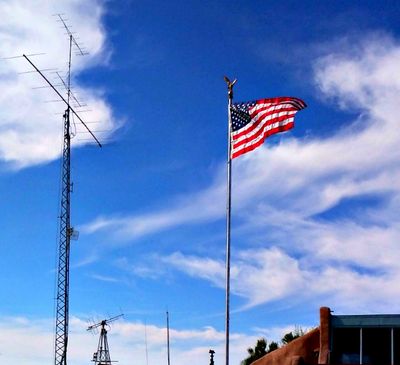
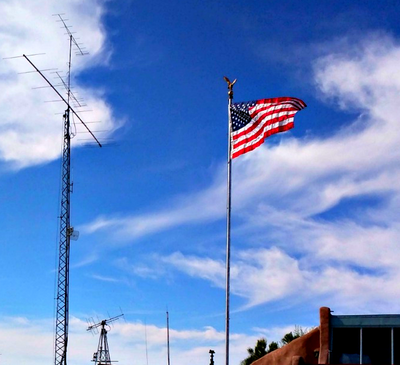
KN4BDC: An RF Engineer Reviews the 24' Greyline Flagpole

Customer Spotlight · KN4BDC
“I’m an RF engineer. Your design is very impressive.”
When a professional RF engineer puts a kilowatt and a half through your antenna and calls the design impressive, that is a different kind of review. Jeff, KN4BDC, feeds his 24’ DX Flagpole with a balanced 300-ohm line and a home-brewed LDMOS amp — and the flower arrangements at the base are still going in.
In Jeff’s Words
“I’m an RF engineer, and your design is very impressive.”
— Jeff, KN4BDC
A professional’s endorsement of the design
Most reviews tell you an antenna works. Jeff’s tells you something rarer: that the underlying engineering holds up to a professional’s eye. He builds RF for a living, and he looked at the vertical-dipole design — off-center fed, no radials, balanced feed — and found it sound. That is the endorsement that is hardest to manufacture and easiest to trust.
He runs the 24’ Greyline across 160 through 10 meters, with good contacts from 40 through 10 depending on conditions. The base is still a work in progress — flower arrangements going in to fold the antenna into the landscaping — which is the whole point of the flagpole form: it disappears into the yard while it works the bands.
The feed: balanced, by the book
Here is where the engineer shows. Jeff feeds the antenna with an MFJ balun into 300-ohm twin-lead for true balanced operation between the top and bottom elements, with an MFJ-998RT remote tuner doing the match. Then he drives it with a home-brewed LDMOS power amplifier, run up to the full legal limit — 1500 watts.
That feed choice is not an accident. A vertical dipole is a balanced antenna; feeding it through a proper balun and balanced line preserves the symmetry the design depends on, rather than fighting it with a single-ended feed and common-mode current. It is exactly the approach the authorities would endorse — the balanced-feed and common-mode story is told clearly by Jim Brown, K9YC, whose work on transmission-line choking is the standing reference, and by Tom Rauch, W8JI. Jeff arrived at it as a working engineer; the physics agrees with him.
The Build
Jeff’s station, end to end.
Antenna: Greyline 24’ DX Flagpole (160M–6M, single feedpoint, no radials).
Feed: MFJ balun into 300-ohm twin-lead, balanced top-to-bottom; MFJ-998RT remote tuner.
Power: Home-brewed LDMOS amplifier, run to the full 1500W legal limit.
Bands: Tunes 160–10M; good contacts 40 through 10M.
Install: Temporary base, flower arrangements going in to conceal it.
For the curious
If the balanced-feed and common-mode side of this is what catches your eye, that is exactly the conversation the contest and DX operators have on the reflectors. The CQ-Contest list is where the station-building discussion lives: lists.contesting.com/_cq-contest/ →
Jeff’s Antenna
24’ DX Flagpole Antenna
160M through 6M from a single feedpoint, no radials, rated to the full 1500W legal limit — and a balanced design an RF engineer signed off on. From thirty feet away it looks like any other flagpole.
More Operator Stories
Worth a read.
NO4ON — Flex Aurora, 13 QRZ Awards, 39’ Greyline →
A flagship digital station, two continents mastered, seven bands of confirmed DX.
RF Mastery: The Physics of Balance →
Why the VDA is a balanced antenna, and why that matters.
73 Greyline Performance — 435-200-4902
Ham Radio is fun again! Pass it on…
Read next · HOA
187 Countries on 35 Watts: Craig W3GF, Seven Years on a 20-Foot Vertical
Operator Spotlight
Two Weeks of Voicemails, Then This: W3GF's 20-Footer and the Whip in a Florida HOA
Signal Lab
The Other Half of Your Antenna Has to Go Somewhere